


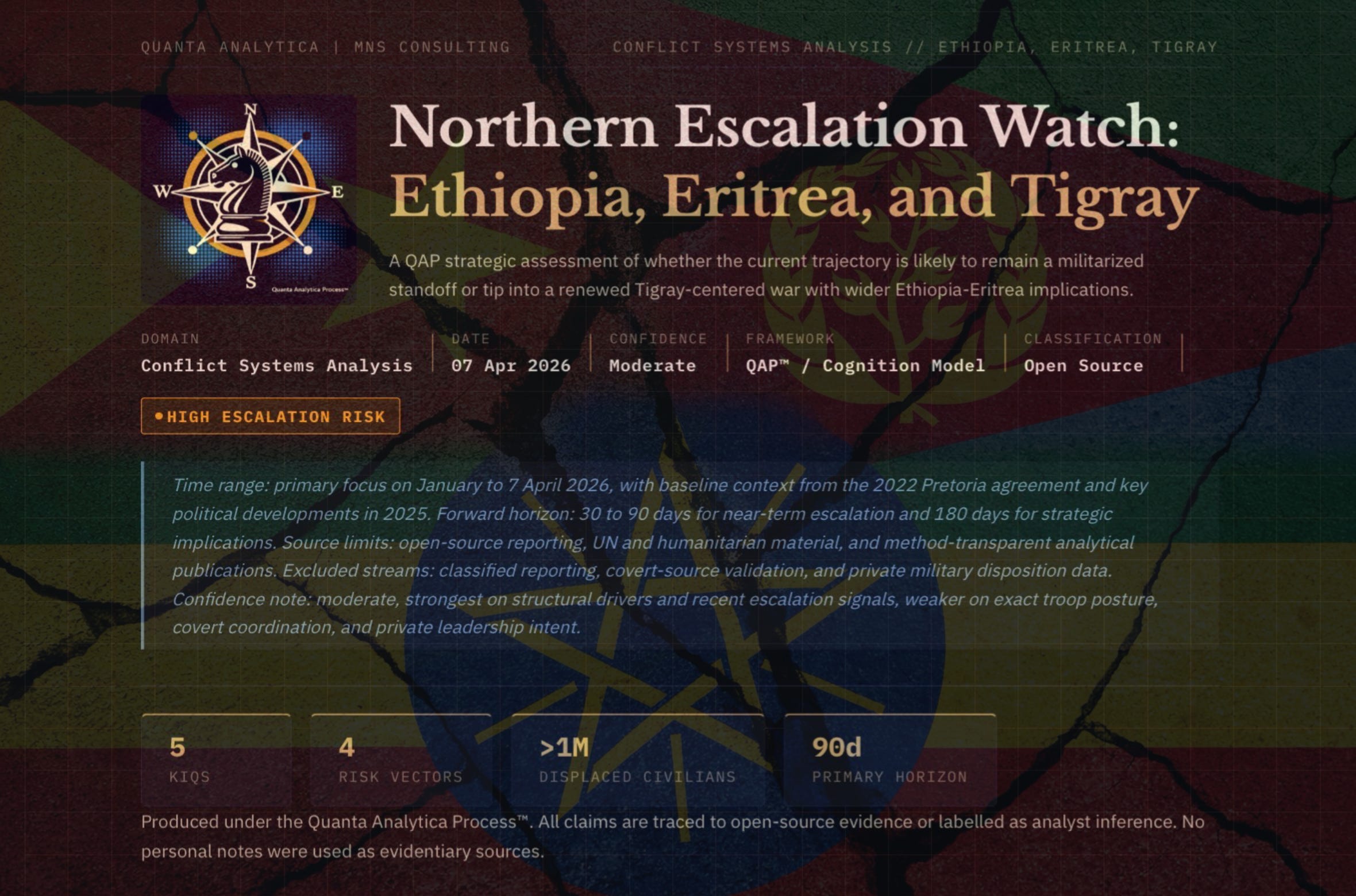
There is a familiar temptation in moments like this to force the Horn of Africa into a simpler story than the facts will support. One version says Ethiopia and Eritrea are sliding back toward direct war. Another says the real danger remains confined to Tigray: a damaged region, a broken settlement, another local relapse. Both readings capture part of the truth. Neither is sufficient.
What is taking shape is more dangerous than either frame on its own. This is not best understood as a clean bilateral crisis between Addis Ababa and Asmara, nor as a self-contained Tigrayan relapse. It is a multi-actor escalation system in which unresolved territorial disputes, Tigray’s political fracture, Eritrea’s exclusion from the postwar settlement, and Ethiopia’s sharpened sovereignty rhetoric over Red Sea access are beginning to reinforce one another. The result is not full war. It is an unstable militarized standoff in which warning time is thinning and miscalculation is becoming more plausible than deliberate large-scale campaign launch. (Reuters)
That distinction matters because it changes the question. The issue is not whether the region has already crossed the threshold into a new war. The issue is whether the political and military architecture left behind by the 2022 Pretoria agreement is strong enough to prevent local clashes, factional maneuvering, and interstate fear from fusing into something wider. The evidence suggests it is not. Reuters has reported recent fighting between Ethiopian national forces and Tigrayan regional forces, as well as drone strikes in Tigray in late January. Ethiopia has formally accused Eritrea of military aggression, occupation of Ethiopian territory, and support to armed groups inside the country. Eritrea has publicly rejected those accusations as fabricated. Those are not isolated data points. They are the visible signs of a settlement that ended large-scale fighting without resolving the issues most likely to restart it. (Reuters)
The deepest problem is not simply mistrust. It is unresolved structure. Pretoria stopped the war, but it did not settle western Tigray, did not fully resolve demobilization, did not restore displaced populations at meaningful scale, and did not produce a political order in Tigray that all relevant actors accept as legitimate. Crisis Group has warned that the triangle formed by Ethiopia, Eritrea, and Tigray has become a powder keg precisely because those unresolved issues now sit inside a broader climate of mutual threat perception. The danger is not that one actor wakes up and chooses catastrophe in a vacuum. The danger is that each actor interprets the others’ moves through a lens already shaped by betrayal, fear, and unfinished war. (Crisis Group)
That is why the internal fracture in Tigray matters so much. It is not a side issue. It is one of the main escalatory engines. A fractured Tigrayan political arena multiplies veto players and weakens coherent bargaining. The result is that local actors can outrun formal leadership decisions. Reuters reported last year that a faction of the TPLF seized control of Adigrat, underscoring how internal splits in Tigray had already become a security issue, not merely a political one. When a region sits inside an unresolved postwar order and lacks a stable, uncontested center of authority, even limited clashes become harder to contain. (Reuters)
The Red Sea issue is the second great amplifier. It is not the sole cause of the current crisis, but it makes the crisis more combustible. Prime Minister Abiy Ahmed’s repeated insistence that landlocked Ethiopia has a right to sea access has raised the strategic salience of Eritrea well beyond the Tigray file. Reuters reported that Eritrea read Ethiopia’s rhetoric as an implicit threat, especially given references to possible access through Assab. Once sea access and sovereignty are fused, bargaining space narrows. Questions that might otherwise remain negotiable begin to feel existential. That is how compromise becomes politically expensive and deterrent signaling becomes harder to distinguish from preparation. (Reuters)
This is why the most useful way to understand the present moment is not through the language of imminent war alone, but through the logic of a security dilemma. Each side’s defensive preparation becomes evidence of hostile intent for the other. Ethiopia sees Eritrean behavior and hardening rhetoric as proof of strategic threat. Eritrea reads Ethiopian talk of sea access, troop posture, and northern instability as a prelude to coercion. Tigrayan actors read both through their own experience of abandonment, exclusion, and existential threat. Once this cycle begins, the threshold for harder signaling drops. Miscalculation becomes more likely than formal declaration. That does not make the situation less dangerous. It makes it more so, because wars born from spiraling interpretations often arrive before the political system has admitted to itself that war is what it is entering. (Quanta Analytica)
The humanitarian dimension is not downstream from this crisis. It is already inside it. The U.N. human rights chief warned in February that the environment in Tigray remained highly volatile and at risk of further deterioration, with continuing human rights and humanitarian danger. Later that month, Volker Türk warned again that clashes between the national army and Tigray security forces had already led to mass displacement, limited humanitarian access, and retaliatory arrests of civilians. The World Food Programme says it urgently requires hundreds of millions of dollars to continue life-saving assistance in Ethiopia, including in conflict-affected northern regions. That means renewed fighting would not strike a stable civilian environment and then degrade it. It would hit a society already carrying unresolved displacement, economic weakness, and aid fragility. (OHCHR)
This is also why the comforting middle position, that the region can simply muddle through another militarized standoff, is only partly reassuring. The Quanta Analytica assessment is right to treat the current surface condition as an unstable standoff rather than confirmed broad war. But “not yet” is doing a great deal of work here. Reuters and AP reporting on flight suspensions, local panic, cash stress, and renewed clashes in early 2026 suggest that even without a formal campaign launch, the population is already responding as if warning time has compressed dramatically. Once flights stop, cash tightens, people queue for fuel, and civilians begin moving on fear alone, local panic becomes part of the escalation environment. It changes behavior before armies move at scale. (Reuters)
There is an opposing view worth taking seriously. One could argue that the region has been through repeated cycles of alarm, accusation, and partial de-escalation before. One could note that public evidence remains stronger on Tigray-centered instability than on a confirmed Ethiopia-Eritrea interstate campaign. That is true, and it is why declaring direct war now would exceed the evidence. But that caution should not be confused with comfort. A system can remain short of full interstate war and still be deteriorating in ways that make a wider conflict materially more plausible. The current danger lies precisely in the fusion of local fighting, factional fragmentation, interstate accusation, and symbolic sovereignty politics. (Quanta Analytica)
What, then, would seriousness look like? Not broad peace language alone. The region needs practical risk reduction around contested districts, clearer communication channels across the most sensitive fault lines, a sequenced roadmap on Tigray’s political status and displaced return, and immediate protection of humanitarian access. Above all, it needs the Assab and Red Sea question separated from coercive signaling while the northern settlement is still this fragile. The alternative is not necessarily instant regional conflagration. It is something in some ways worse: recurrent clashes, deepening fear, and a series of small escalatory steps that eventually remove the political room for restraint. (Quanta Analytica)
The most dangerous part of this crisis, then, is not only the troop movements, the accusations, or the drone strikes. It is the story each side is telling itself about what those things mean. Once military preparation is read as proof, once compromise is reframed as humiliation, and once a damaged postwar order is forced to carry more strategic weight than it can bear, the system begins to reward the people least interested in restraint.
This is not yet the worst case. That is the warning.
Read the full assessment:
https://quanta-analytica.com/reports/ethiopia-eritrea-tigray-7apr2026-report.html
References
[1] Reuters. Ethiopia accuses Eritrea of military aggression, backing armed groups. February 8, 2026.
https://www.reuters.com/world/africa/ethiopia-accuses-eritrea-military-aggression-backing-armed-groups-2026-02-08/
[2] Reuters. Eritrea calls Ethiopia’s accusations of military aggression “deplorable”. February 9, 2026.
https://www.reuters.com/world/africa/eritrea-calls-ethiopias-accusations-military-aggression-deplorable-2026-02-09/
[3] Reuters. Ethiopian Airlines restarts flights to Tigray region, official says. February 3, 2026.
https://www.reuters.com/world/africa/ethiopian-airlines-restarts-flights-tigray-region-official-says-2026-02-03/
[4] International Crisis Group. Ethiopia, Eritrea and Tigray: A Powder Keg in the Horn of Africa. February 18, 2026.
https://www.crisisgroup.org/africa/horn-africa/ethiopia-eritrea/b210-ethiopia-eritrea-and-tigray-powder-keg-horn-africa
[5] OHCHR. Ethiopia: Türk urges restraint and steps towards de-escalation amid rising tensions in Tigray. February 10, 2026.
https://www.ohchr.org/en/press-releases/2026/02/ethiopia-turk-urges-restraint-and-steps-towards-de-escalation-amid
[6] AP News. Ethiopia’s national carrier cancels flights to Tigray region as fears grow of renewed fighting. January 30, 2026.
https://apnews.com/article/142daa3702199385ab5a66478af752b1
[7] AP News. Ethiopia’s Tigray region is caught between past conflict and fears of another. February 22, 2026.
https://apnews.com/article/a89d6c79ded625d65e7105697fda785c
[8] World Food Programme. Ethiopia emergency. Accessed April 7, 2026.
https://www.wfp.org/emergencies/ethiopia-emergency