


There is a tendency to describe the crisis in eastern Democratic Republic of Congo as a peace process in need of repair. That framing is understandable. Two formal frameworks the Doha process signed in November 2025 and the Washington Accords signed in December 2025 represent serious diplomatic investment by Qatar, the United States, and the African Union. When those processes stall, the natural instinct is to ask what the next round of talks might accomplish. Who needs to be in the room. What language might unlock the impasse.
But that framing misreads the situation at its core. The eastern DRC conflict is not a negotiation problem. It is a structural one. The parties are not failing to agree because they lack a capable mediator or the right incentives framework. They are failing to agree because the current state of the conflict, active, costly, and internationally embarrassing, is still preferable to the available alternatives for each of the three actors most responsible for sustaining it. Until that calculation changes, no framework will hold.
What is actually happening in eastern DRC is a controlled partition, not a war waiting to end.
M23 and its political umbrella, the Alliance Fleuve Congo, seized Goma in January 2025. By early 2026, the group controls Goma, Bukavu, and large swathes of North and South Kivu, operating parallel administrations governance, taxation, security that have now been in place for more than a year [1]. A fourth major recruitment cycle completed in February 2026 reportedly brought M23’s active combatant strength to approximately 27,000 [2]. Whether that figure is precise or not, the direction is unmistakable. This is not a rebel movement holding territory while it waits to negotiate. It is an armed actor building a state.
Rwanda’s role in that process is no longer speculative. Rwanda’s ambassador acknowledged before the US Congress in January 2026 that his government maintains “security coordination” with M23 [3]. UN documentation has long established the presence of Rwandan Defence Force troops and weapons systems operating in eastern DRC. The US imposed sanctions on the RDF as an entity and on four of its senior officials in early March 2026 [3]. That is a significant step. It is not, however, sufficient to change Kigali’s fundamental calculation which is that continued military engagement in eastern DRC provides both a security buffer against the FDLR, the Hutu armed remnants whose presence Rwanda invokes to justify its engagement, and material access to one of the most mineral-rich corridors on the continent.
Coltan, gold, tungsten, and tin move through eastern DRC’s economy. They move through M23-controlled territory. And they connect to Rwanda’s broader export economy in ways that create rational economic pressure to maintain access rather than negotiate it away [1][2]. This is not an allegation. It is a structural feature of the environment that any serious analysis of the conflict must account for.
The Congolese government’s position is equally constrained, but for different reasons.
Kinshasa insists on unconditional M23 withdrawal, full disarmament, and cantonment before any political dialogue. M23 insists on political power-sharing and formal autonomy as the price of disengagement. These positions are not merely far apart. They are structurally incompatible. Kinshasa cannot offer political recognition to an armed group without establishing that armed insurrection is a viable path to power, a precedent the government regards as existential, given the DRC’s more than 100 other armed actors operating in the east [1]. M23 cannot disarm without guarantees that no past agreement has ever delivered. Neither side has an incentive to move first.
The drone campaign now unfolding in Q1 2026 reflects this logic. The Congolese military has conducted more than 60 documented drone strikes since January, including a strike near Rubaya on February 24 that killed M23’s spokesperson [3]. M23 responded with a drone strike on Kisangani’s Bangoka International Airport, a geographic escalation beyond previous frontlines [3]. This is not the behavior of parties preparing to concede. It is the behavior of parties signaling resolve while the diplomats meet.
The current responses, sanctions, mediation, & frameworks are not wrong. They are insufficient against the actual problem.
US sanctions on the RDF matter. They signal a cost. But Rwanda has absorbed them without altering its strategic posture, because the economic and security benefits of continued engagement in eastern DRC still outweigh the friction. The Doha and Washington frameworks matter. They provide a reference point and a platform. But both frameworks require parties to comply with terms they have not complied with, and there is no enforcement mechanism capable of compelling behavior change on the ground [3][4]. MONUSCO, the UN mission, has severely limited access to M23-held territory and a mandate under review. The International Contact Group condemned ceasefire violations in March 2026 and commended the Togolese mediation effort language that accurately describes frustration and limited actionable capacity [4].
Meanwhile, the humanitarian system is approaching a breaking point that is itself a threat multiplier. OCHA launched a $1.4 billion humanitarian appeal in January 2026 [5]. In 2025, only 24 percent of the year’s requirements were funded [5]. More than 14.9 million people require humanitarian assistance this year. Over 200,000 civilians were displaced in South Kivu’s Minembwe highlands alone by late February [6]. Cholera, mpox, and measles outbreaks are not projected risks; they are current conditions. A humanitarian collapse at this scale does not remain separate from the security environment. It deepens recruitment pipelines for armed groups, erodes what remains of civilian trust in state institutions, and creates ungoverned spaces that armed actors exploit.
The broader regional picture adds pressure without providing relief.
Burundi has aligned itself with Kinshasa, creating a potential southern axis against M23. But Burundi-Rwanda bilateral tensions introduce their own escalation risk, with a cross-border incident capable of opening a second front that fragments the diplomatic effort [1]. The AU’s transition to Togolese mediation under President Gnassingbé adds institutional capacity, but the diplomatic space Angola helped create and then stepped back from in early 2025 has not been fully replaced.
If current conditions persist through the second quarter of 2026, the trajectory points toward entrenchment, not resolution.
The base case prolonged deadlock with episodic escalation carries the highest probability precisely because it requires no action from any party. M23 consolidates. Rwanda absorbs sanctions. Kinshasa seeks external military partnerships to compensate for a structurally fragile army. Drone strikes continue at elevated frequency. The humanitarian system frays further. Peace frameworks remain on paper.
What could change that trajectory is not a better framework text. It is a shift in the cost-benefit calculation of at least one of the three principal actors, specifically Rwanda. A sequenced approach that links concrete economic cooperation agreements to verifiable RDF withdrawal, combined with sustained and escalating sanctions pressure, would make continued engagement materially more expensive than a negotiated exit. That is not a guarantee of success. But it is the only mechanism with a plausible causal path to altering Rwanda’s behavior, which is the load-bearing variable the current diplomatic architecture has not yet addressed directly.
The peace process in eastern DRC is not failing because the diplomats are not trying hard enough. It is failing because the structural incentives of the conflict have not been confronted directly. Naming that clearly is the starting point for any response that could actually work.
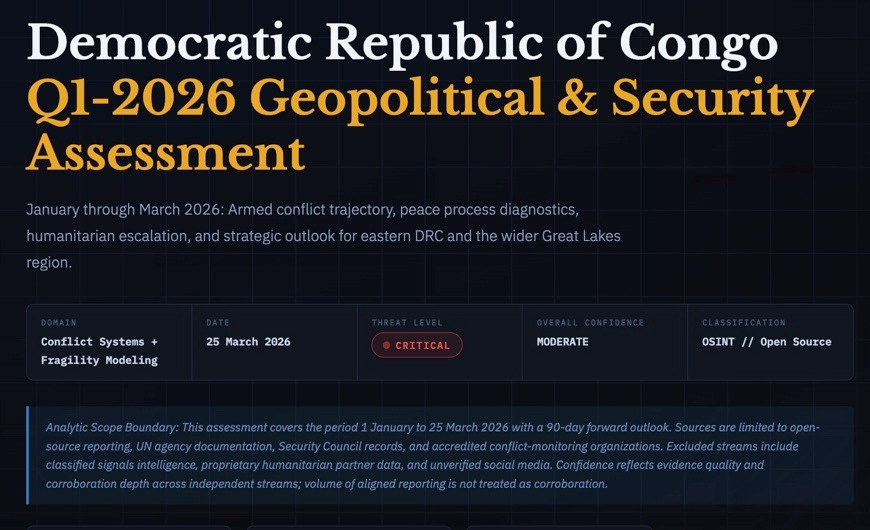
Read the full assessment: Democratic Republic of Congo Q1-2026 Geopolitical & Security Assessment
References
[1] International Crisis Group. The M23 Offensive Elusive Peace. December 22, 2025. https://crisisgroup.org/africa/great-lakes/democratic-republic-congo/320-m23-offensive
[2] Al Jazeera. Banks Shut, One Year After M23 Seized Goma. January 29, 2026. https://www.aljazeera.com/features/2026/1/29/banks-shut-futures-uncertain-one-year-after-m23-rebels-seized-drcs-goma
[3] Security Council Report. DRC Closed Consultations March 2026. March 2026. https://www.securitycouncilreport.org/whatsinblue/2026/03/democratic-republic-of-the-congo-closed-consultations-5.php
[4] GlobalSecurity.org / International Contact Group. ICG Statement on DRC Ceasefire Violations. March 5, 2026. https://globalsecurity.org/military/library/news/2026/03/mil-260305-ffo01.htm
[5] OCHA. Democratic Republic of the Congo: Facing a Critical Funding Gap. January 28, 2026. https://unocha.org/publications/report/drc/facing-critical-funding-gap
[6] ACAPS. DRC Crisis Analysis. February 2026. https://acaps.org/en/countries/drc