


The Coalition That Was Always Coming: What the Mali offensive reveals about Tuareg mobilization, the limits of fragile peace, and what our Q1 2026 Sahel assessment now requires us to update
Nuri Shakoor | Flashpoints & Frameworks | Quanta Analytica / MNS Consulting | April 2026
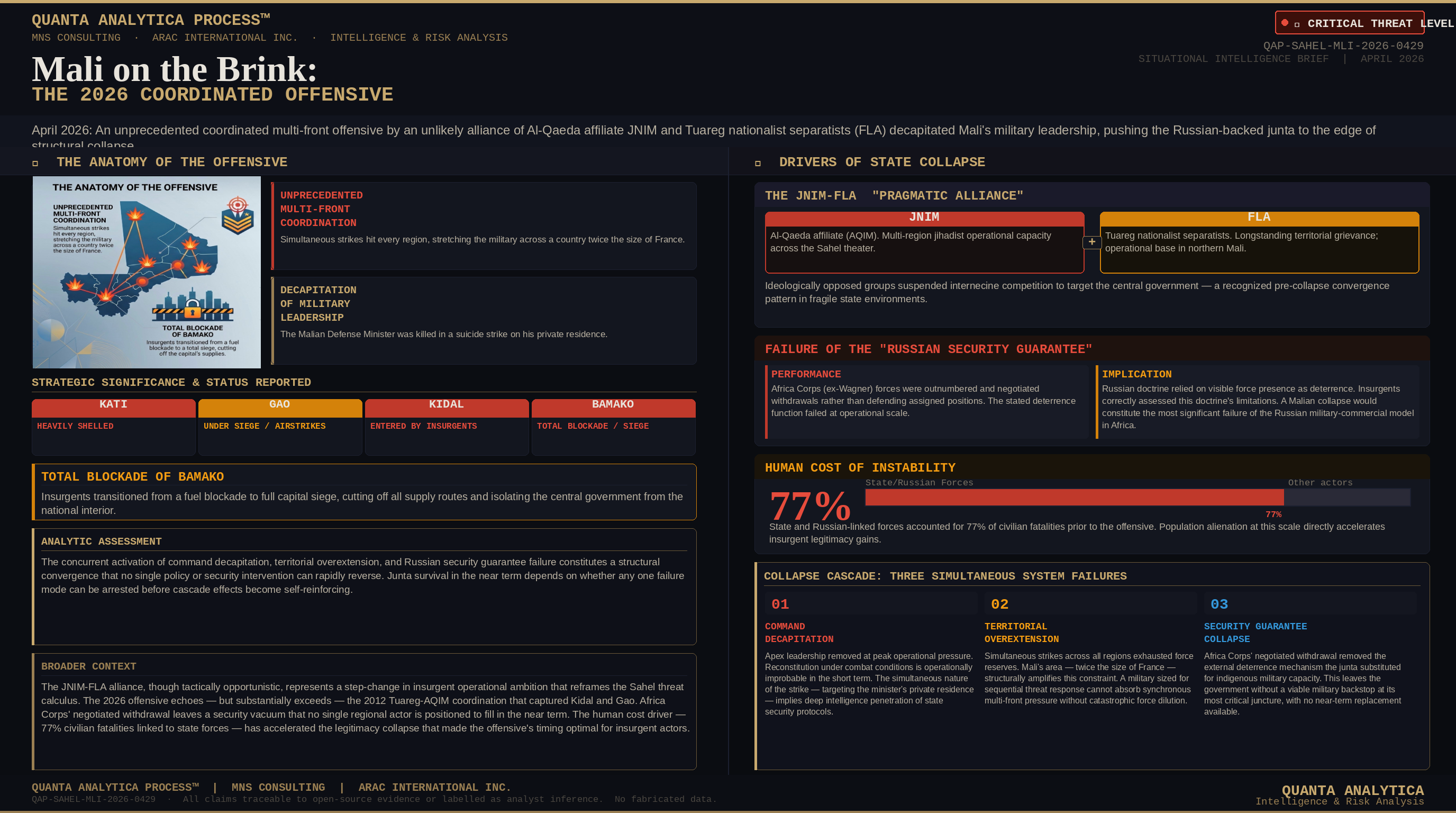
When armed groups move on a capital, the instinct is to reach for the language of eruption: a crisis that arrived without warning, driven by extremist opportunism or battlefield momentum. That instinct is already shaping coverage of the April 25 offensive in Mali, in which the Azawad Liberation Front and the jihadist coalition JNIM launched coordinated attacks from Kidal to the outskirts of Bamako, killed the defense minister, and drove Russian Africa Corps forces out of their northern positions.
That framing is wrong. Not because the attacks were anticipated in their precise timing or operational scale, but because every actor, every alliance, and every structural condition that made them possible was identifiable well before they occurred. The question worth asking now is not what happened. It is why the pattern that produced this moment was so persistently underread.