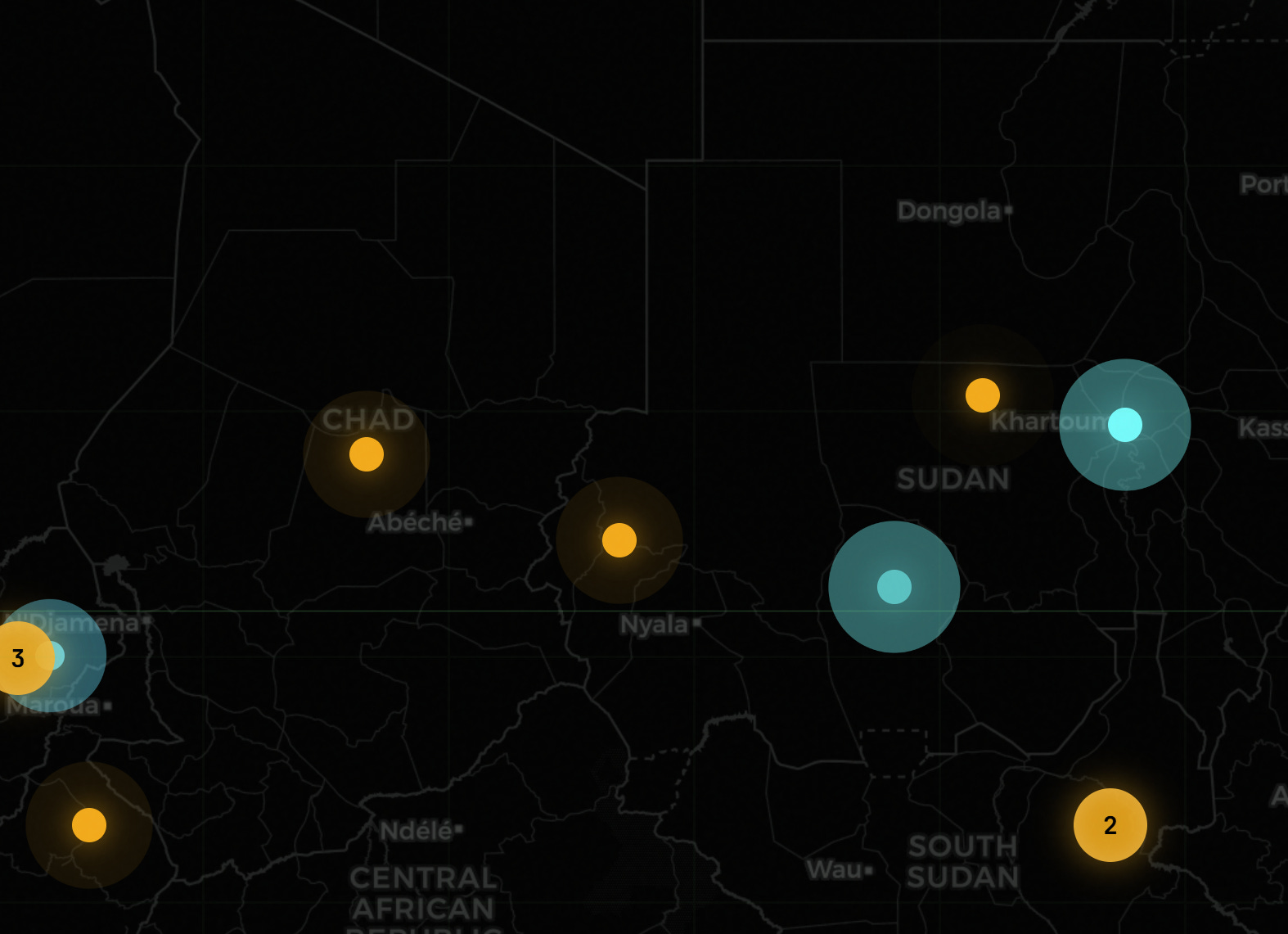


The Border Is Not Failing. The System Is…
There is a habit in international reporting to describe crises like the Chad–Sudan border situation as “spillover.” It sounds contained. Manageable. Temporary.
It’s none of those things.
What’s unfolding along that border is not a spillover event; it’s a system under strain, breaking in real time.
The violence in Sudan, particularly across Darfur, is not staying put. It is moving, through people, through armed groups, through fear. And every time it crosses into Chad, it doesn’t just arrive. It multiplies.
Refugees don’t cross alone. They bring trauma, urgent needs, and pressure on already fragile communities. Local systems, food, water, security, governance, stretch thin. When they stretch too far, they don’t bend. They fracture.
And when they fracture, new instability begins.
This is how one conflict becomes many.
A Cycle That Feeds Itself
Look closely at what’s happening, and a pattern emerges.
Violence pushes people out of Sudan. Those people arrive in Chad. Their arrival strains resources. That strain creates tension. Tension opens space for recruitment, for armed actors, for opportunists. And that, in turn, feeds the very violence that started the cycle.
It doesn’t loop back neatly. It expands.
Here’s how the mechanism actually works. Displacement concentrates vulnerable populations in border areas where state presence is already thin. The Rapid Support Forces and affiliated Arab militias operating across Darfur have demonstrated a consistent pattern: they follow displacement corridors, not just front lines. As refugees move, so does the operational geography of the conflict. Chad’s eastern provinces, particularly Ouaddaï and Sila, absorb not just people but the social fractures those people are fleeing: ethnic tension, land disputes, and the presence of armed men who have crossed with the civilian flow or recruited from within it. Local Chadian communities, themselves under resource pressure, read this not as a humanitarian event but as a security one. That perception shift is where governance starts to lose ground. When communities stop trusting the state to manage the situation, they begin managing it themselves, through customary authority, through alignment with armed actors, or through pre-emptive mobilization. Each of those responses creates new instability, independent of what Sudan does next.
What began as a conflict inside Sudan is now shaping conditions inside Chad. And those conditions are becoming part of the conflict itself.
That’s the part most observers miss. This isn’t a chain reaction. It’s a feedback system.
Why Containment Isn’t Working
There’s an assumption, often unspoken, that borders can hold crises in place.
But borders only work when the systems behind them are strong enough to enforce them.
Chad is being asked to absorb the consequences of a war it didn’t start, with limited capacity and competing internal pressures. Humanitarian support helps, but it moves slower than the crisis itself. Security responses exist, but they are reactive, not preventative.
So the gap widens.
Between what is happening and what can be managed.
Between pressure and response.
That gap is where instability grows.
The Problem Isn’t Events, It’s What Produces Them
Most coverage focuses on what’s visible:
New waves of refugees
Cross-border attacks
Armed group movement
But those are outcomes, not causes.
The real issue is the environment producing them, one where weak governance, armed mobility, and economic strain intersect. In that environment, instability isn’t accidental. It’s predictable.
And once it becomes predictable, it becomes repeatable.
This Isn’t Just a Border Crisis
It’s tempting to frame this as a bilateral issue between Chad and Sudan.
It’s not.
What’s happening here sits at the intersection of broader regional dynamics, Darfur’s long-running conflict, Sahelian instability, and the movement of armed actors across poorly governed spaces.
These are not isolated problems. They’re connected.
And when they connect, they don’t cancel each other out. They reinforce each other.
What This Means Going Forward
Situations like this don’t resolve on their own.
They either stabilize through deliberate, sustained intervention, or they continue to expand until they force a larger crisis.
Right now, the indicators point in one direction: continued strain, continued movement, continued risk of escalation.
Not because of a single event.
But because the underlying conditions haven’t changed.
The Bigger Picture
The Chad–Sudan border is not an exception.
It’s a warning.
It shows what happens when conflict, displacement, and weak state capacity intersect without enough force to stabilize them. It shows how quickly a local crisis becomes a regional one. And it shows how misleading it is to think in terms of containment when the system itself is open.
The border isn’t failing.
It’s reflecting reality.
Read the Full Assessment
This piece is a high-level view. The full analysis goes deeper, mapping the drivers, the actors, and the risk trajectories shaping this crisis.
If you want the complete picture, including structured assessment and forward-looking implications:
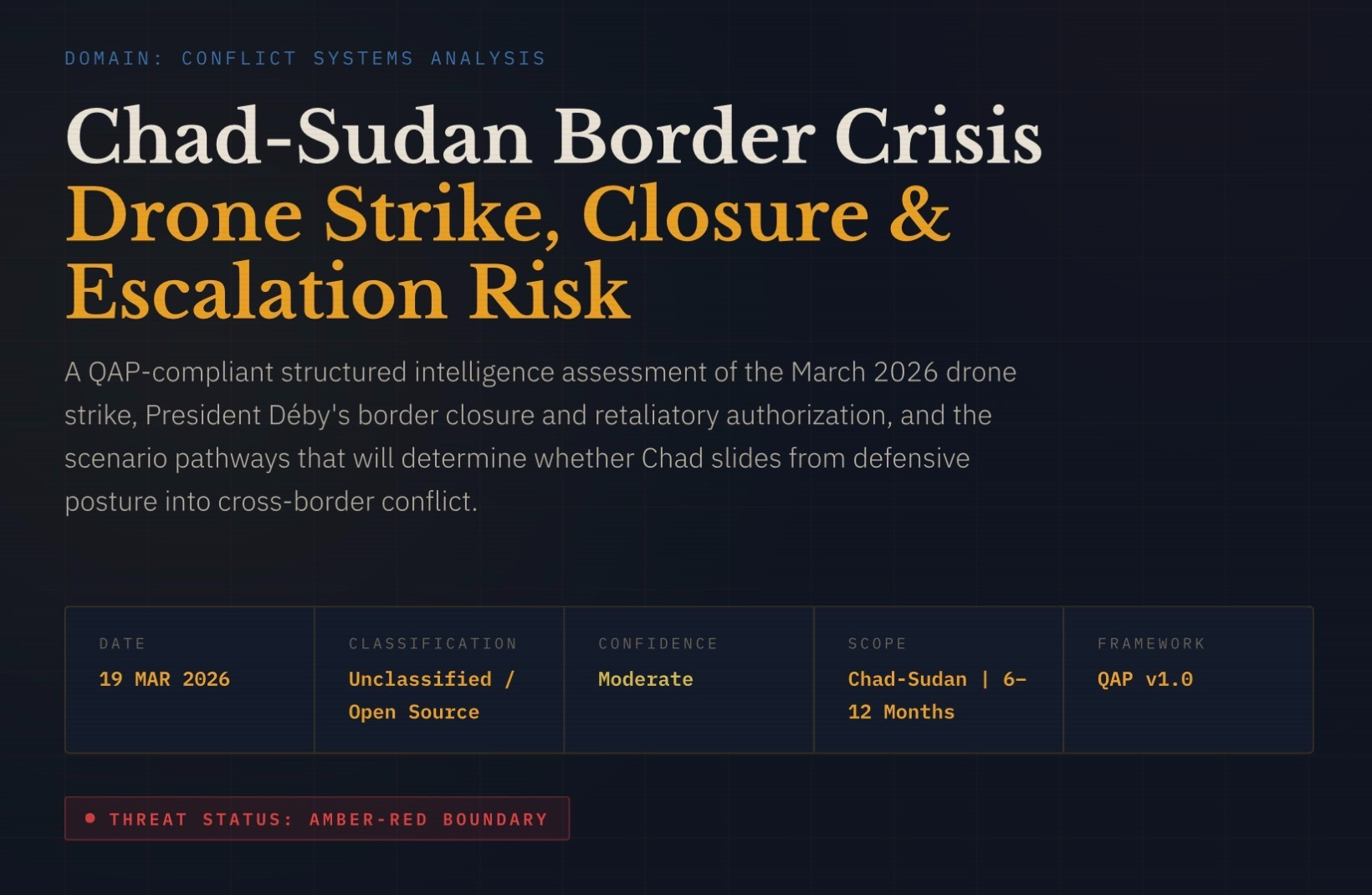
👉 Chad-Sudan Border Crisis | Quanta Analytica Process™ | 19 MAR 2026
Bottom Line
If this keeps getting treated as a border problem, we will keep getting border-level solutions.
And those solutions will keep failing.
Because the real problem, the one shaping everything we’re seeing, is the system behind it.
Recommended applications World - Monitor