

FLASHPOINTS & FRAMEWORKS
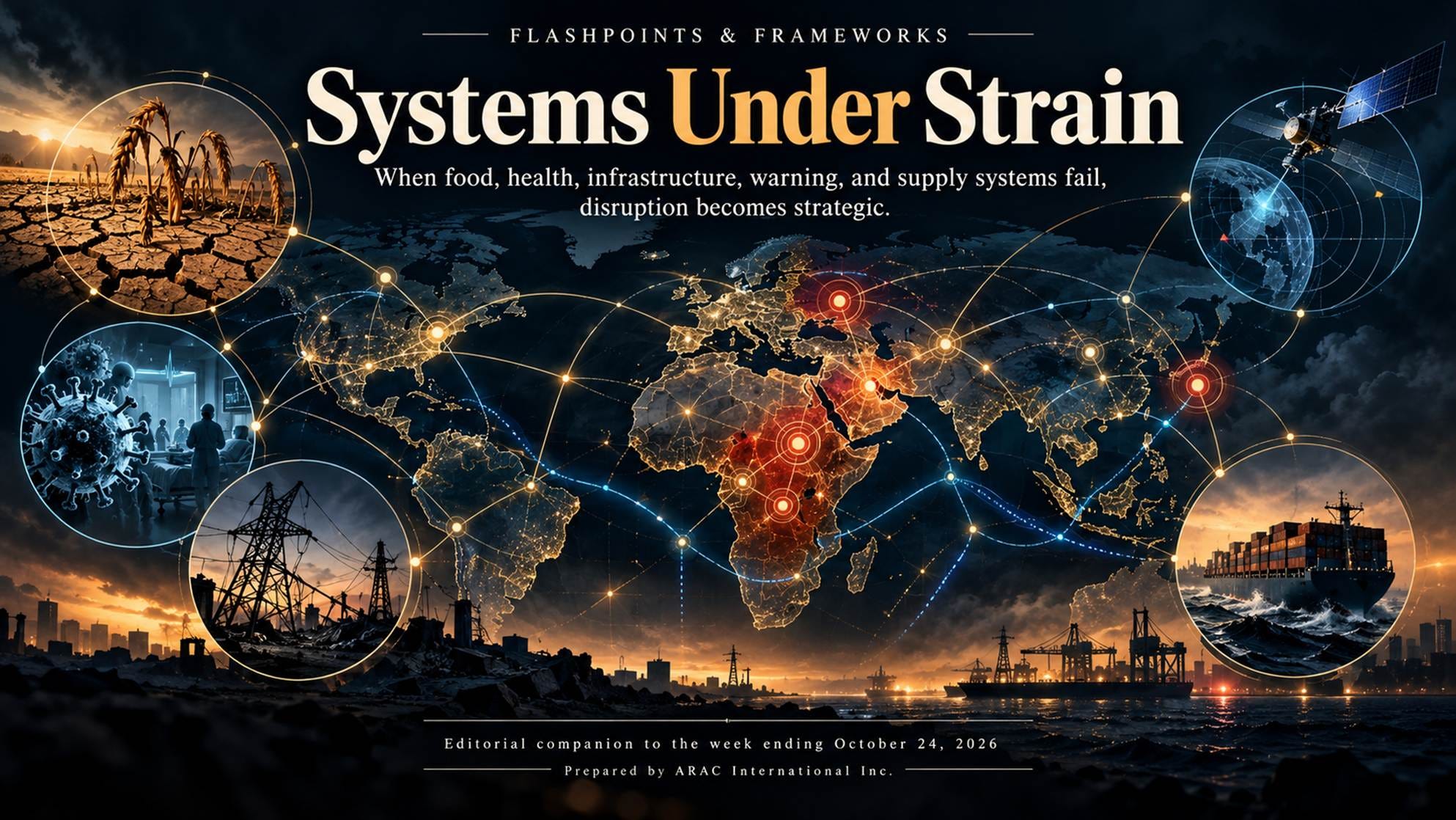
Systems Under Strain
Why the next strategic surprise may come from the failure of food, health, infrastructure, warning, or supply systems rather than from a dramatic change on the battlefield.
SubStack newsletter companion to the week ending October 24, 2026
This week’s global security picture is defined by convergence. In Sudan, drought is amplifying a war-driven food crisis. In the Democratic Republic of the Congo, Ebola has expanded into another province while surveillance remains uneven. In Ukraine, physical infrastructure pressure is now interacting with uncertainty over warning and external support. In the Middle East, attacks are transmitting directly into oil prices, freight rates, tanker behavior, and refinery purchasing decisions.
The deeper pattern is dependency
The October 24 edition shifts the analytical focus from individual incidents toward the systems that absorb their effects. A strike, drought, outbreak, or coercive act becomes strategically important when the affected society or market lacks a timely substitute. That is why the report examines not only threat and vulnerability, but also dependency concentration, substitution capacity, recovery time, and visibility.
The critical question is not only what can be disrupted, but what cannot be substituted quickly enough when disruption occurs.
Sudan: conflict meets food-system failure
Sudan now illustrates how separate stresses can become self-reinforcing. Drought is reducing agricultural production while war constrains markets, displacement increases dependency, and humanitarian organizations face funding and access limits. The resulting risk is not simply higher food prices. It is the erosion of the entire system connecting production, transport, purchasing power, assistance, and household survival.
DRC: outbreak numbers are not the same as outbreak visibility
The Ebola outbreak’s expansion into an eighth province reinforces a standing QAP warning: national case totals do not provide a complete measure of epidemiological control. Analysts have to examine how much transmission is visible, where surveillance coverage is weak, whether new cases are linked to known chains, and how cross-border movement changes the denominator.
Ukraine and the Middle East: infrastructure is only as resilient as the systems behind it
Ukraine’s vulnerability now includes the continuity of warning, intelligence, and external support in addition to damaged electricity and transport infrastructure. In the Middle East, the strategic effect of maritime insecurity is visible through economic behavior: higher oil prices, altered tanker choices, elevated freight costs, and changes in refinery procurement. These are system effects, not merely event counts.
Taiwan: coercion without invasion
Taiwan’s security environment continues to demonstrate that coercion can target social networks and industrial dependencies without crossing the threshold into conventional war. Organized-crime investigations and efforts by TSMC to reduce rare-earth exposure highlight two very different but strategically related forms of dependency.
What the full report adds
· A full QAP distinction between facts, interpretation, and analytic judgment.
· CARVER scoring focused on recuperability and dependency concentration.
· Integrated RCA/CPS analysis covering root causes, Positive Peace systems, prevention, stabilization, partnerships, and monitoring.
· Signals and warning dashboard covering Sudan, DRC, Ethiopia-Eritrea, Ukraine, the Middle East, Taiwan, Mozambique, the Sahel, and emerging European risks.
· 30-, 90-, and 180-day structured outlooks.
Read the full assessment and a special bonus updated analysis on Mozambique Displacement available for paid subscribers
See our new Quanta AI Aggregators in action by becoming a paid subscriber. By joining our Patreon, you gain access to the methods, frameworks, and theoretical models that I used to train our custom AI applications and analytic platforms to produce high-quality analytic reports, leaving you the analyst and researchers in complete control.