


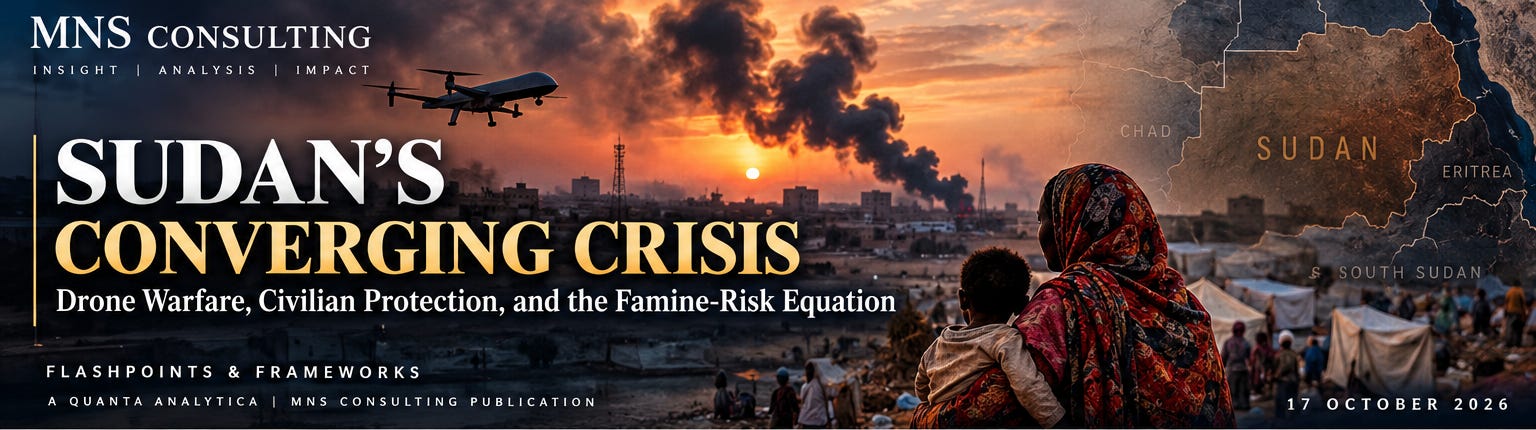
Why the Nyala market strike and Darfur’s worsening nutrition indicators should be examined as one strategic failure, not two separate headlines.
Flashpoints & Frameworks | MNS Consulting | 17 October 2026
A drone strike on a livestock market in Nyala and a deteriorating humanitarian outlook across Darfur and Kordofan may appear to be different crises. One is immediate and visible: shattered infrastructure, casualties and contested military claims. The other is cumulative: malnutrition, displacement, collapsing livelihoods and dwindling access to lifesaving services.
The distinction is descriptive, not causal. These dynamics interact, and their convergence is precisely what makes Sudan’s trajectory so dangerous.
The central analytical question is not whether drones are now an important feature of the conflict. That much is established. It is whether belligerents and their external interlocutors can establish verifiable protections for civilians while enabling the humanitarian systems on which civilian survival depends.
Nyala: the event and the evidentiary boundary
On 16 October 2026, a strike hit the busy livestock market in Nyala, the capital of South Darfur. A medical source speaking to AFP reported 30 people killed and 47 wounded. Accounts associated with the Rapid Support Forces (RSF) gave a lower wounded figure of 43 and blamed the Sudanese Armed Forces (SAF). The SAF separately reported attacks on RSF positions and command centres in Nyala. Those claims do not, by themselves, resolve responsibility for the market strike. [1][2]
Three distinctions matter.
First, a figure repeated by several news organizations does not become several independent confirmations when the reporting traces back to the same medical source. Second, a party’s statement about its opponent is evidence of an allegation, not proof of attribution. Third, uncertainty about the precise platform or command chain must not obscure the verified humanitarian significance of an attack on a crowded civilian marketplace.
The operational issue extends beyond this incident. In June, UN High Commissioner for Human Rights Volker Türk reported that drone strikes had killed more than 1,000 civilians in Sudan during the first five months of 2026. The UN’s October briefing continued to describe drone and air attacks affecting civilian sites across multiple regions. [3][4]
This is a transformation in the geography of risk. Rear-area markets, schools, shelters, transport routes and health facilities cannot be assessed solely by their distance from a ground front. Civilian protection increasingly requires attention to aerial exposure and its consequences for everyday systems.
The second front is nutritional, not merely military
On 12 October, the Integrated Food Security Phase Classification (IPC) issued an alert identifying worsening famine risk across parts of Greater Darfur and Greater Kordofan. The drivers were mutually reinforcing: conflict, mass displacement, severe drought, weak harvest prospects, humanitarian funding shortfalls and constrained access. [5][6]
Among children accessing nutrition services in Nyala, the proportion admitted with severe acute malnutrition reportedly increased from 5.2% in January to 11.4% in August 2026. That is a rise of 6.2 percentage points, and the latter value is approximately 2.19 times the former. Across Greater Darfur, 13 of 17 nutrition surveys identified Critical levels of global acute malnutrition. [5][7]
These numbers demand precision. The Nyala measure reflects children who reached services and were admitted with severe acute malnutrition. It is not a population-wide prevalence rate. The January and August observations do not establish what happened in every intervening month. Likewise, 13 of 17 surveys is a description of surveyed locations, not a valid estimate that 76% of all children across Darfur are malnourished.
Even with those limits, the warning is substantial. War diminishes household income and mobility; drought reduces food production and access to water; insecurity disrupts transport and treatment; and restricted access weakens the capacity to measure the consequences. Each of these mechanisms reinforces the others.
A further distinction is essential: an IPC alert concerning famine risk is not equivalent to a blanket formal famine classification. The warning describes an increasingly hazardous trajectory and the urgency of preventive action. [5][6]
Mediation must be assessed by what can be verified
Public diplomacy is moving, but movement is not the same as an agreement. Addressing the Security Council on 16 October, UN Under-Secretary-General Rosemary DiCarlo described continued deterioration, the civilian danger posed by aerial attacks and efforts to advance a humanitarian truce and confidence-building measures. UN communications also referenced initiatives concerning prisoner exchanges and access to education. [4][8]
A preliminary MNS Consulting brief raised the prospect of a separately tabled drone-regulation proposal and identified consultations reportedly scheduled for 20-21 October as a potential test. In reviewing the publicly available sources for this edition, we could not independently substantiate the specific procedural claim that such an instrument had formally been tabled. It would therefore be analytically unsound to present that step as a confirmed diplomatic breakthrough. [9]
What should determine whether a meaningful opening exists? Not the announcement of another meeting, nor a general appeal for restraint. The relevant evidence would be a document or attributable statement identifying the parties, the proposed operational restrictions, the geographic scope and the mechanism through which violations would be observed and addressed.
Until such indicators emerge, a distinction remains between diplomatic intent, negotiated commitments and observed implementation.
Root Cause Analysis / Conflict Prevention & Stabilization (RCA/CPS)
A narrow focus on the weapon system would capture only one dimension of Sudan’s instability. Within the RCA/CPS framework, the problem is best understood as the interaction of several conditions:
Civilian exposure: Aerial strikes threaten people and the places on which daily survival depends.
Service-system degradation: The loss or disruption of health, nutrition, water and market functions increases the consequences of insecurity.
Access constraints: Impeded humanitarian movement can turn manageable health emergencies into avoidable mortality.
Livelihood collapse: Drought, displacement and market disruption reduce the capacity of households to absorb shocks.
Verification deficit: Claims of restraint, culpability or diplomatic progress are difficult to translate into trust without independent evidence.
These are not isolated causal channels. They form a feedback system. Damage to a marketplace can interrupt commerce and income. Loss of income reduces access to food. Poor nutrition increases susceptibility to illness. A weakened health system then faces rising need with fewer resources. The outcome is an expanding protection crisis even in areas where no major ground battle is underway.
The corresponding stabilization requirement is therefore integrated: civilian-site protections, sustained access, nutrition and medical continuity, water and livelihood support, and credible mechanisms for verifying commitments. A ceasefire that reduces some strikes but leaves food and medicine unable to move may produce an important yet incomplete improvement.
Four indicators that deserve attention now
For the next 30 to 60 days, the analytical priority should be to determine whether claims and intentions are producing observable changes.
Written and attributable commitments: Do the parties acknowledge specific constraints on attacks against civilians or civilian infrastructure, with provisions for monitoring?
Verified humanitarian movement: Are relief convoys repeatedly able to reach communities in Darfur and Kordofan, rather than merely being promised access?
Comparable protection and nutrition reporting: Are casualty investigations, clinic access, malnutrition admissions and market conditions being documented consistently enough to identify genuine improvement?
Credible attribution evidence: Do independent investigators establish what can and cannot be concluded about specific strikes, platforms and external participation?
The strongest early indicator will not necessarily be a political declaration. It may be evidence that roads remain open, supplies arrive safely, treatment centres operate, and fewer civilians are harmed.
The strategic judgment
Sudan’s immediate challenge is to reduce civilian harm. Its deeper challenge is to prevent the continued destruction of the systems that make civilian survival possible.
That distinction should discipline both analysis and diplomacy. Drone restrictions, where verifiable, could lower one significant form of exposure. Yet even an effective agreement would not, by itself, reverse drought, restore markets, reopen clinics or guarantee humanitarian access. Conversely, emergency food delivery without meaningful civilian protection would remain vulnerable to the same violence that makes it necessary.
The issue is not a choice between security and humanitarian action. In Sudan, the two have become inseparable.
Read or download the complete MNS Consulting executive assessment (PDF), including redesigned casualty and nutrition visualizations, source-confidence assessments, the RCA/CPS matrix, and a 30-60 day indicator watchlist.
References
[1] The New Arab Staff & Agencies. (2026, October 17). Drone strike kills 30 at cattle market in Sudan’s Darfur. The New Arab. https://www.newarab.com/news/drone-strike-kills-30-cattle-market-sudans-darfur
[2] Al Jazeera Staff & AFP. (2026, October 17). Sudan’s army claims killing of dozens of RSF fighters in Nyala attack. Al Jazeera. https://www.aljazeera.com/news/2026/10/17/2550
[3] Associated Press. (2026, June 15). Drone strikes kill over 1,000 civilians in Sudan in the first 5 months of 2026, UN rights chief says. https://apnews.com/article/88f883750a3846c237fa3a62add55d7f
[4] United Nations Department of Political and Peacebuilding Affairs. (2026, October 16). Remarks by USG DiCarlo to the Security Council on Sudan. https://dppa.un.org/en/node/137063
[5] Integrated Food Security Phase Classification. (2026, October 12). Sudan: New evidence reveals rapidly worsening conditions across Greater Darfur and Kordofan. https://www.ipcinfo.org/ipcinfo-website/countries-in-focus-archive/issue-157/en/
[6] World Health Organization. (2026, October 12). IPC Sudan food insecurity and malnutrition alert. https://www.who.int/news/item/12-10-2026-ipc-sudan-food-insecurity-and-malnutrition-alert
[7] Radio Tamazuj. (2026, October 13). Darfur and Kordofan face rising famine risk, IPC warns. https://www.radiotamazuj.org/en/news/article/darfur-and-kordofan-face-rising-famine-risk-ipc-warns
[8] United Nations Department of Political and Peacebuilding Affairs. (2026, October 16). This week in DPPA: 10-16 October 2026. https://www.unmissions.org/en/dppa/news/this-week-in-dppa-10-16-october-2026
[9] MNS Consulting. (2026, October 17). Executive brief: Sudan, escalating drone violence, mediation moves, and deepening food-security crisis. Supplied working assessment; unverified procedural claim retained only as a watch item.
Prepared by MNS Consulting for Flashpoints & Frameworks. Public-interest, independent analysis. Evidence distinctions and analytic judgments reflect sources available as of 17 October 2026. A finding of uncertainty is not a finding of absence.
From Signal to Decision-Grade Analysis
How ARAC International, Quanta Analytica and MNS Consulting structure an AI-assisted information and intelligence pipeline?
For paid subscribers