


What three years of data, a vanishing institution, and $1.5 billion in unmet needs tell us about how atrocity persists
Flashpoints & Frameworks | M. Nuri Shakoor
There is a tendency to describe Sudan’s civil war as a humanitarian catastrophe. A tragedy of enormous scale that has, unfortunately, resisted resolution. That framing is not wrong. But it is incomplete in a way that matters.
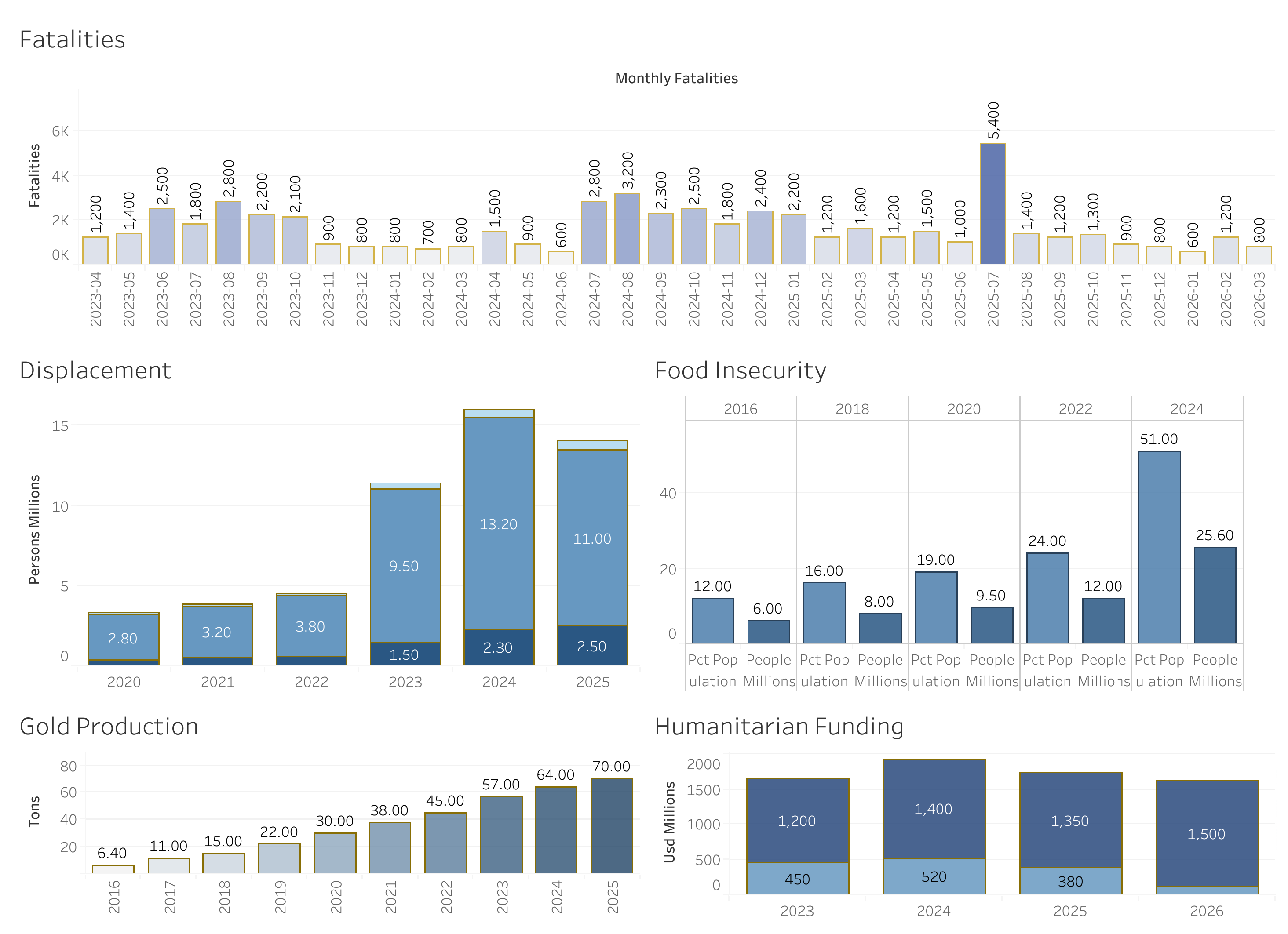
Tragedy implies misfortune. What is happening in Sudan is not misfortune. It is a war being actively sustained by gold markets, by weapons flows, by diplomatic silence, and by a funding architecture that has now collapsed so thoroughly that only eight percent of humanitarian needs will be met in 2026 [1]. That is not the signature of a tragedy running its course. It is the signature of a system operating more or less as designed.
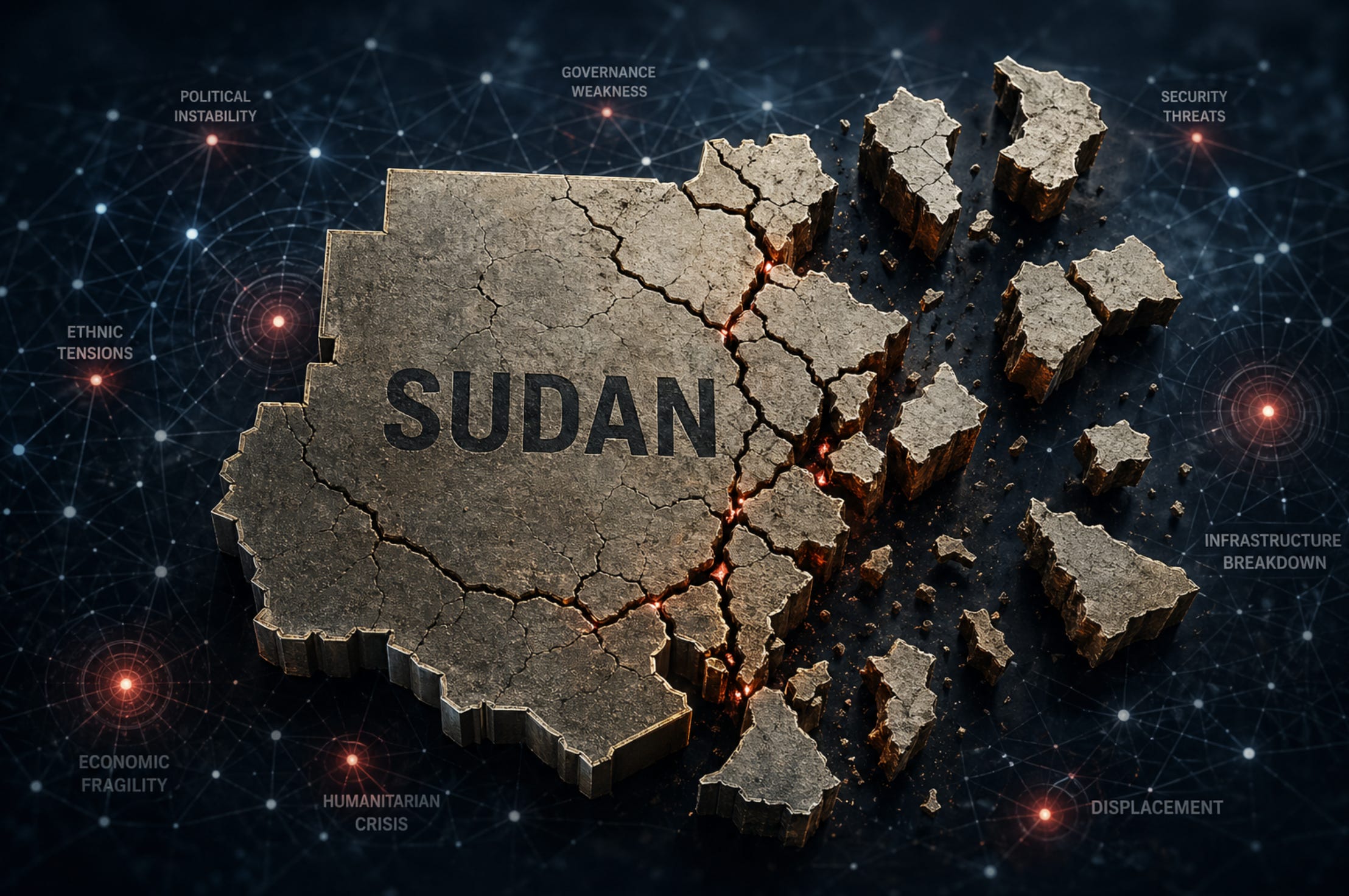
Sudan entered its fourth year of civil war on April 15, 2026. The Sudanese Armed Forces (SAF) and the Rapid Support Forces (RSF) remain locked in what independent analysts now characterize as a grinding war of attrition, with the SAF holding the country’s east and the RSF controlling the west [2]. The territorial logic is simple. The humanitarian logic is devastating.
More than 58,000 deaths have been recorded by the Armed Conflict Location and Event Data Project since the fighting began. And that figure, as ACLED notes, almost certainly undercounts the actual toll, which independent estimates place between 150,000 and 400,000 [1][2]. Over 11 million people have been internally displaced. A further four million have fled into Chad, Egypt, and South Sudan. The populations that previously sheltered in Sudan from conflicts elsewhere, nearly 900,000 people from South Sudan, Ethiopia, and the Central African Republic, have been forced back into the environments they originally fled [2]. The displacement does not stay inside borders. It compounds fragility across an already strained region.
The food system has effectively collapsed. In 2022, roughly 24 percent of Sudan’s population faced acute food insecurity. By 2024, that figure had risen to 51 percent, more than 25 million people [1]. Famine, formally confirmed in August 2024 at the Zamzam displacement camp, has since expanded to multiple localities. The healthcare system sits at 39 percent functionality, having absorbed 721 documented attacks on facilities, staff, and supply chains since the war began [1]. DTP vaccine coverage for children has fallen from 84 percent in 2022 to 39 percent in 2024 [2]. The malaria burden, which was already rising before the war, has surged past five million estimated cases annually [2].
None of this is accidental.
The structural reality of Sudan’s war is that it has become self-financing. Sudan’s gold production reached 70 tons in 2025, surpassing official targets by 13 percent [2]. Both the SAF and the RSF use gold extraction and export to purchase weapons, compensate fighters, and sustain operations. The UAE is the primary destination for both declared and undeclared Sudanese gold [2]. The United States Treasury’s Office of Foreign Assets Control has sanctioned UAE-based Capital Tap Holding for providing money and weapons to the RSF [3]. The UN Panel of Experts has described the main RSF resupply route running through eastern Chad, with cargo rotations tracing back to Abu Dhabi [4]. Yale’s Humanitarian Research Lab documented activity consistent with RSF military assistance at an Ethiopian National Defense Force base in Asosa as recently as early 2026 [5]. Eastern Libya, through Haftar-linked networks, has served as a further logistics corridor.
The point is not that the UAE is uniquely villainous in a morally simple story. The point is that the conflict has generated an external support architecture spanning the Gulf, North Africa, and the Horn, keeping both parties operational. The SAF receives backing from Egypt, Iran, Turkey, Russia’s Africa Corps, and Ukraine [2]. External actors have staked interests in Sudan’s strategic position on the Red Sea, in its mineral resources, and in regional rivalry dynamics that have little to do with the welfare of Sudanese civilians. When over ten countries are actively choosing sides, the conflict ceases to be internally resolvable through internal pressure alone.
The African Union’s role in this environment is where the analysis becomes somewhat uncomfortable yet interesting.
The AU Peace and Security Council has condemned external interference in Sudan. It has tasked its own mechanisms to identify external supporters. But the reviewed February 2026 communiqué does not name the UAE [3]. It does not name any actor. It uses generalized language that condemns a category of behavior without identifying who is engaging in it. The February communiqué created a three-month identification mandate. Meaning a credible public process update was due by May 2026. Whether that update materializes is, at this point, the central institutional test.
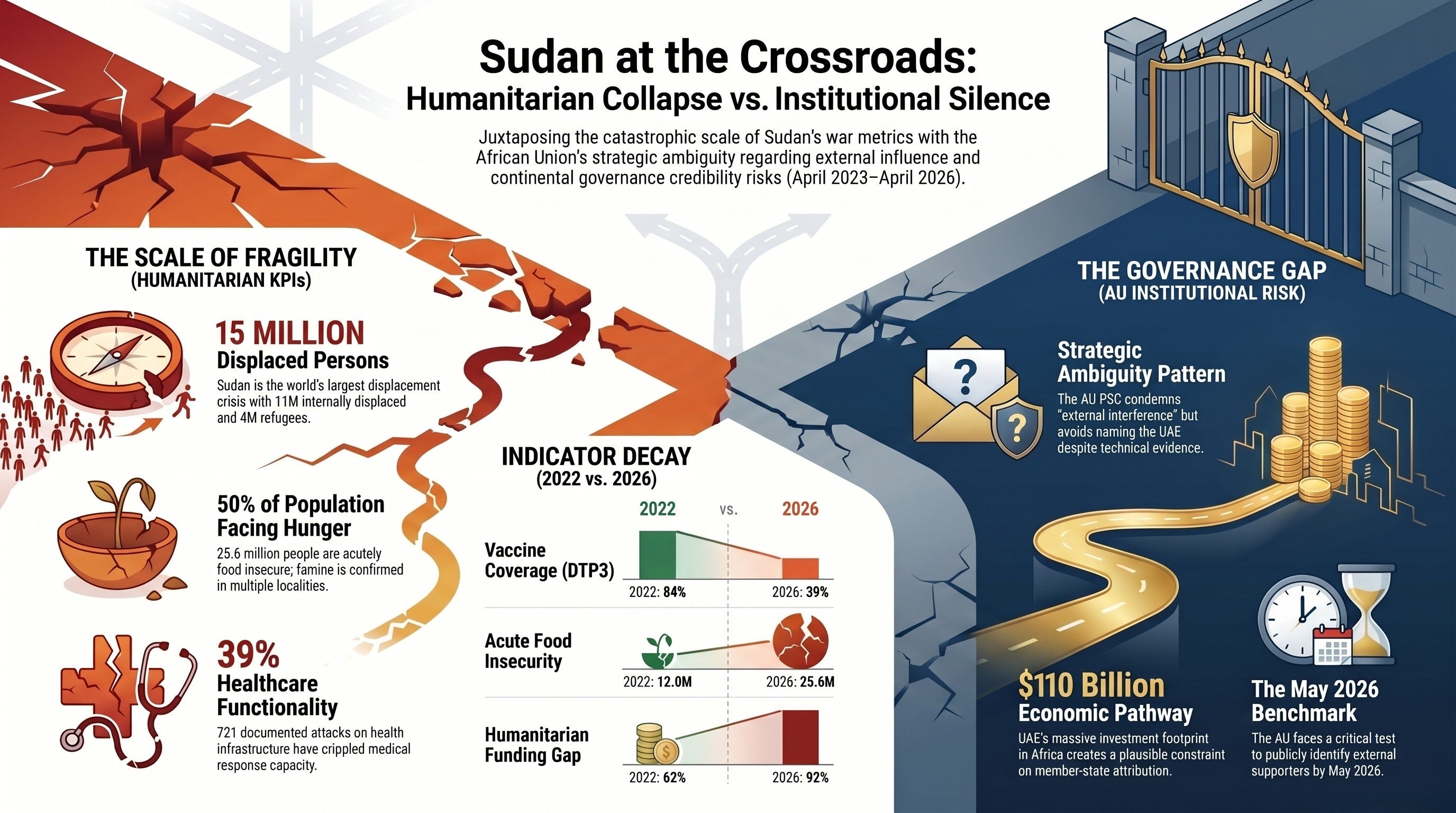
The most defensible explanation for AU non-attribution is not corruption or capture. It is a combination of pressures: the consensus-preserving norms of the PSC, the mediation-access incentives that come from maintaining relationships with all parties including the UAE, legal and evidentiary caution in a contested evidence environment, and the economic exposure of AU member states to over $110 billion in UAE investments across Africa since 2019 [3]. None of those factors individually proves that the AU is being managed. Together, they create a structural condition in which generalized language becomes the institutionally rational output regardless of what individual member states privately believe.
The risk of that condition is not primarily legal. It is behavioral. When the AU’s language remains static while the technical, sanctions, UN, and investigative evidence base continues to expand (as it has); the silence does not read as caution to affected populations, civil society, or external observers. It reads as selective restraint. That perception, whether accurate or not, erodes the institutional credibility that makes AU engagement in future crises worth anything.
Current responses struggle for a reason that is not primarily a resource problem, though the resource problem is severe. When humanitarian funding peaks at 38 percent of need in the best year and falls to eight percent in 2026 [1], the shortfall is not a budgeting failure. It is a signal about political will in donor capitals that have concluded, correctly or not, that the situation is either intractable or insufficiently strategically proximate to justify sustained commitment. That calculation is shaped by how the conflict is framed, and framing it as tragedy, rather than as a sustained system with identifiable actors making identifiable choices, reduces the political cost of inaction.
The mechanism is straightforward. When a war appears to be a force of nature rather than a product of decisions, the question shifts from accountability to relief. Relief is more expensive than accountability at the front end and cheaper at the back end only if it actually works, which it does not when 92 percent of needs go unmet. The framing of tragedy naturalizes a system that is, in fact, political.
Sudan’s war matters beyond Sudan for a reason that has nothing to do with proximity. It is one of the clearest current demonstrations of what happens when a conflict internationalizes beyond the governance capacity of existing continental and multilateral institutions. The AU has the mandate. It lacks the enforcement architecture and, under current conditions, the member-state alignment to exercise it against powerful economic partners. That gap between what a continental body is designed to do and what it can actually do when the external actors involved are also investors and conveners is not unique to Sudan. It is likely to recur in any theater where economic dependency and security accountability intersect.
If the May 2026 benchmark passes without a credible AU attribution process, that absence becomes a data point. Not evidence of capture, but evidence of incapacity under constraint. Either conclusion demands a response from those who care about the institutional framework that conflict governance depends on.
The data is clear. The mechanisms are traceable. The choices being made by armed factions, external sponsors, and multilateral bodies are choices. Not fate. That is worth understanding precisely.
This commentary draws on open-source intelligence reporting and analysis produced under the Quanta Analytica Process™ framework.
Read the full assessments:
Sudan Conflict Intelligence Dashboard (Data Visualization + Year Four Overview): https://quanta-analytica.com/reports/sudan-conflict-dashboard-v2.html
African Institutional Silence and External Influence in Sudan’s War (AU Credibility Assessment): https://quanta-analytica.com/reports/sudan-external-influence-report.html
References
[1] Quanta Analytica Process™. Sudan Conflict Intelligence Dashboard — Year Four Situation Overview. MNS Consulting / ARAC International Inc. 21 April 2026. https://quanta-analytica.com/reports/sudan-conflict-dashboard-v2.html
[2] Nzuki, C. et al. The Sudan War in 10 Charts. Center for Strategic and International Studies. 17 April 2026. https://www.csis.org/analysis/sudan-war-10-charts
[3] Quanta Analytica Process™. African Institutional Silence and External Influence in Sudan’s War. MNS Consulting. 26 April 2026. https://quanta-analytica.com/reports/sudan-external-influence-report.html
[4] UN Panel of Experts on Sudan. Report on External Sustainment Networks. United Nations Security Council. 2025–2026. https://documents.un.org/doc/undoc/gen/n24/005/64/pdf/n2400564.pdf
[5] Yale Humanitarian Research Lab. Activity Assessment: Asosa Airbase, Ethiopia. Yale University. March 2026. https://files-profile.medicine.yale.edu/documents/6fd54e48-167c-4af0-995b-942bee4727f9
[6] ACLED. Sudan Conflict Data — Monthly Fatality Tracking. Armed Conflict Location and Event Data Project. April 2026. https://acleddata.com/
[7] UNHCR. Sudan Emergency Displacement Figures. United Nations High Commissioner for Refugees. April 2026. https://www.unhcr.org/sudan-emergency
Behind the Analysis: How We Built the Sudan Assessments
A QAP™ Tradecraft Note for Paid Subscribers
This post explains how we applied Structured Analytic Techniques to produce two recent Sudan assessments: the Sudan Conflict Intelligence Dashboard (April 21, 2026) and “African Institutional Silence and External Influence in Sudan’s War” (April 26, 2026). We want you to see not just what we concluded, but how we got there.