


THE DIGITAL NAVIGATOR | GLOBAL SECURITY & HUMANITARIAN AFFAIRS Two-Part Report.
Part I. When Fear Becomes the Threat: Ebola, Misinformation, and the Collapse of Trust in Congo
Part II. When Corruption Becomes Credible: How Government Distrust Fuels the Ebola Misinformation Cycle
Part I. When Fear Becomes the Threat: Ebola, Misinformation, and the Collapse of Trust in Congo
The killing of a nurse in Bafwasende reveals a dangerous reality: an epidemic becomes substantially harder to contain when the people entrusted with protecting communities become the targets of the communities they serve.

By M. Nuri Shakoor | Global Security Analyst | ARAC International Inc.
October 26, 2026 | Editorial Analysis
Imagine being a nurse in a community struggling with a deadly infectious disease. You have spent years treating the sick, reassuring frightened families, and explaining how a virus spreads. You know the community. The community knows you.
Then something changes.
Rumors begin circulating that the disease is not what medical authorities claim it is. Some residents become convinced that health workers are responsible for spreading the very illness they have been sent to contain. Fear turns into suspicion. Suspicion becomes hostility. And eventually, the people who once depended upon you for medical care begin to regard you as a threat.
This is no longer an imagined scenario.
In Bafwasende, in the Democratic Republic of Congo’s Tshopo province, a nurse involved in the Ebola response was killed during an attack reported over the weekend of October 24, 2026. Another person was seriously injured. According to Reuters, other health workers subsequently sought refuge inside the local hospital under police protection, fearing further violence. Local reporting indicates that the attackers accused medical personnel of contaminating community water sources and spreading Ebola [1][2].
Consider the implications.
A hospital, normally a place where frightened civilians seek protection from disease, has become a refuge for frightened medical personnel seeking protection from civilians.
That reversal should concern anyone involved in public health, humanitarian operations, peacebuilding, or national security.
Because what we are witnessing in Bafwasende is not simply another episode of violence against healthcare workers. It is evidence of a deeper structural vulnerability in epidemic response: the loss of public trust can become as operationally consequential as the biological threat itself.
And unlike the Ebola virus, distrust cannot be isolated in a treatment center.
The disease is biological. The crisis is also social.
Ebola is a formidable public health threat. Its transmission can be interrupted through timely identification of cases, infection prevention, contact tracing, appropriate clinical care, safe burial practices, and community cooperation.
But every one of these interventions depends, to varying degrees, on human behavior.
People must be willing to report symptoms. Families must trust medical teams sufficiently to permit treatment. Communities must cooperate with contact tracers. Residents must believe that public health guidance is intended to protect them rather than harm them.
These are not secondary considerations. They are fundamental operating conditions for an effective response.
In Bafwasende, local reporting published October 25 indicates that the health zone had recorded 19 Ebola cases and nine deaths. Three confirmed patients reportedly left treatment facilities before completing their care, while local medical authorities described difficulty obtaining community cooperation in locating them [3].
We should be careful not to assume that every treatment departure was directly caused by misinformation. Individual motivations require investigation.
Nevertheless, the combination of violence against health personnel, hostility toward responders, and interruptions in patient management points toward an increasingly compromised operating environment.
The chain of consequences is not difficult to understand.
When healthcare workers become targets, their willingness and ability to operate outside protected facilities deteriorate. When medical teams reduce their presence, surveillance and community engagement may suffer. When surveillance weakens, the probability of undetected transmission increases. And when transmission becomes more difficult to control, fear can deepen further.
This creates a potentially self-reinforcing cycle.

This is where the challenge moves beyond public health and enters the domain of security risk management.
An epidemic response is an interconnected system. Its operational capacity depends not only on medicines, personnel, vehicles, or funding, but also on whether communities permit that capacity to function.
A fully supplied treatment center is of limited value if infected people are too frightened to enter it. A well-trained response team cannot trace contacts effectively if residents conceal information or threaten its members.
The infrastructure may remain standing while the system itself begins to fail.
Misinformation does not emerge in a vacuum
There is a temptation, particularly among external observers, to explain attacks like the one in Bafwasende by describing local populations as ignorant, irrational, or easily manipulated.
That interpretation is convenient.
It is also analytically inadequate.
Misinformation rarely gains lasting influence merely because someone circulates a false statement. It becomes powerful when that statement connects with existing fears, unresolved grievances, institutional weaknesses, or experiences that make official explanations appear unconvincing.
In communities where people have endured recurring insecurity, limited public services, corruption, economic exclusion, or poorly explained interventions, distrust may already be deeply embedded.
An unfamiliar medical procedure can then appear threatening. Protective clothing may be interpreted as evidence of concealment. Restrictions on burial practices can collide with religious or cultural expectations. And the arrival of emergency funding, international organizations, and specialized response teams may generate questions about who benefits from the crisis.
These concerns do not make false allegations true. Nor do they justify violence.
But they help explain why simply telling communities that a rumor is false may not be enough to neutralize its influence.
The critical distinction is between correcting misinformation and understanding why people find it credible.
A public health official may believe the challenge is a deficit of accurate information. A conflict analyst may see an underlying deficit of institutional legitimacy. A community member may simply want assurance that the people entering their neighborhood are accountable, accessible, and genuinely concerned about their welfare.
Each is looking at a different dimension of the same problem.
And unless those dimensions are reconciled, factual corrections alone may have limited effect.
This also raises an important question about the origins of the rumors themselves.
Were the allegations against health workers spontaneous expressions of community anxiety? Were they amplified by influential local figures? Did prior disputes with medical authorities contribute to the hostility? Or were particular individuals deliberately exploiting existing fears?
These are different hypotheses, requiring different evidence.
There is no basis in the verified reporting reviewed here to attribute the Bafwasende violence to a coordinated foreign influence operation or organized political campaign.
We should not turn an incident caused amid misinformation into another exercise in speculation.
What is evident is that false beliefs acquired enough behavioral influence to contribute to violence against people providing essential medical services.
That alone is a serious security concern.
When protection becomes another source of mistrust
The immediate response to violence against health workers is understandably a security response.
Police are deployed. Hospitals receive protection. Authorities investigate the perpetrators. Medical personnel may be escorted through areas where hostility has intensified.
These measures can be necessary, particularly when credible threats to life have already materialized.
But they also introduce a difficult operational dilemma.
What happens when a community that already distrusts medical authorities begins to associate healthcare delivery with armed security forces?
For some residents, police protection may communicate that health workers are vulnerable professionals who deserve safety. For others, particularly in communities with negative experiences of coercive authority, the same deployment may reinforce suspicions that the public health response is being imposed rather than conducted in partnership with them.
Neither reaction should be assumed to represent an entire community.
The point is that security measures do not operate in a social vacuum.
An appropriate response must protect medical personnel without unnecessarily transforming healthcare into a confrontation between authorities and civilians.
This requires distinguishing violent offenders from the broader population. It requires proportionate security measures, transparent investigations, and continued engagement with residents who may be frightened but are not responsible for the attacks.
Most importantly, it requires recognizing that physical security and community acceptance are complementary, not interchangeable.
Armed protection can reduce immediate exposure to violence.
It cannot manufacture public legitimacy.
The lessons we should have learned
The Democratic Republic of Congo has confronted this intersection of disease, insecurity, and distrust before.
During the 2018–2020 Ebola outbreak in the eastern provinces, violent attacks, suspicion of medical responders, and community resistance complicated outbreak containment. The World Health Organization documented the impact of insecurity on response operations, while research examining community perceptions found that distrust and misinformation were associated with lower willingness to accept certain preventive measures [4][5].
There is an important distinction between learning that community trust matters and designing institutions that treat trust as an essential operational capability.
We have known for years that epidemic response requires community engagement.
Yet engagement is still too often approached as a communication activity conducted after technical and security plans have already been established.
First, authorities determine the intervention. Then medical teams deploy. Then communication specialists explain the intervention. And when communities resist, the problem is categorized as misinformation.
But what if this sequence is itself part of the vulnerability?
What if community relationships, local perceptions, and institutional legitimacy need to be examined before deployment decisions are finalized?
What if community acceptance is not merely a desirable outcome of a public health response, but one of the conditions that makes the response possible?
The lessons from eastern Congo suggest that technical competence, however necessary, cannot compensate indefinitely for deteriorating relationships between institutions and the people they serve.
And this brings us to a broader issue of governance.
Trust is infrastructure, too
When analysts assess the resilience of a society, they frequently examine physical infrastructure: roads, electricity, telecommunications, hospitals, supply chains, and transportation networks.
These are tangible systems whose deterioration can be observed and measured.
But societies also depend on less visible infrastructure.
Public confidence. Institutional credibility. Social cohesion. The capacity to resolve disagreements without violence. The ability of communities and authorities to cooperate during periods of uncertainty.
These conditions correspond closely with several pillars of Positive Peace, including well-functioning government, the free flow of information, low levels of corruption, and the acceptance of the rights of others [6].
They are not abstract ideals disconnected from operational realities.
They affect whether information is believed, whether warnings are accepted, whether officials can act effectively, and whether communities cooperate when confronted with a shared threat.
In Bafwasende, the killing of a nurse is an immediate human tragedy. But the surrounding hostility exposes a wider vulnerability: a healthcare system can lose its capacity to reach people even before its physical resources are exhausted.
The same dynamic can emerge during vaccination campaigns, cholera outbreaks, humanitarian relief operations, disaster evacuations, or conflict-related displacement.
A government may possess the resources to deliver assistance but lack the credibility necessary for residents to accept it.
A humanitarian organization may have funding and technical expertise but insufficient understanding of the community’s political and social environment.
An international response may achieve rapid deployment while failing to establish the relationships necessary for sustained access.
These are not exclusively medical problems.
They are failures at the intersection of governance, security, communication, and human behavior.
This is why the distinction between public health preparedness and societal resilience is increasingly difficult to maintain.
What Bafwasende should change
The response to the killing must begin with accountability and protection. Those responsible for violence should be investigated through credible legal processes. Threatened health workers must be able to perform their duties safely.
But a longer-term approach must move beyond securing facilities and correcting rumors.
Community engagement needs to become a continuous process of listening, explaining, addressing grievances, and demonstrating accountability. Trusted local healthcare professionals, religious figures, educators, community associations, and civil society representatives should participate in shaping the response rather than merely repeating messages developed elsewhere.
Health authorities should also treat threats, refusals of care, attacks on personnel, and the circulation of harmful allegations as indicators of possible operational deterioration.
Not as proof that transmission will increase, but as early warnings that the conditions necessary to contain transmission are weakening.
This would allow decision-makers to examine two related forms of risk: the epidemiological trajectory of the disease and the social conditions affecting the ability to respond.
Neither can be adequately understood in isolation.
There is also an ethical responsibility here.
Communities experiencing fear and confusion should not be collectively blamed for the actions of violent individuals. At the same time, cultural sensitivity cannot become an excuse for tolerating attacks against healthcare personnel.
An effective response must defend both principles: the right of communities to receive trustworthy, accountable healthcare and the right of health workers to provide that care without intimidation.
The warning beyond Congo
There is a deeper lesson in Bafwasende that extends well beyond Ebola.
We live in an information environment where public perceptions can change faster than institutions can respond. Rumors can circulate through personal networks, local conversations, messaging applications, and political discourse before authorities have established a credible account of events.
And once a false belief becomes connected to fear, identity, grievance, or perceived injustice, correcting the factual record may not immediately reverse the resulting behavior.
This is what makes misinformation a security concern rather than merely a communications problem.
Its consequences can become physical.
People may refuse treatment. Families may avoid health facilities. Communities may obstruct humanitarian operations. Workers may withdraw from dangerous environments.
Under these conditions, the information environment begins influencing the availability and effectiveness of essential services.
Yet we should resist treating every episode of distrust as evidence of a sophisticated information campaign. Sometimes the explanation is less dramatic, and more uncomfortable.
Institutions may have failed to build relationships strong enough to withstand uncertainty.
That possibility deserves as much scrutiny as the rumors themselves.
The nurse killed in Bafwasende was not simply another casualty in a public health emergency. His death illustrates how quickly the relationship between a community and its caregivers can deteriorate when fear overwhelms confidence.
And the image of medical professionals sheltering inside a hospital under police protection should force us to reconsider what it actually means for a public health response to be operationally secure.
Security is not achieved merely because responders can enter a community with protection.
It is achieved when they can perform their work safely, when residents can seek care without fear, and when institutions retain enough credibility to mobilize cooperation during a crisis.
The immediate challenge in Bafwasende is to restore the conditions necessary to contain Ebola while protecting those working to save lives.
The larger challenge is to recognize that trust is not something authorities can improvise after a crisis has begun.
It must be built before it is needed, maintained when institutions are questioned, and defended when misinformation threatens to turn communities against themselves.
Because when the people trying to stop an epidemic are forced to hide from the people they are trying to save, we are no longer dealing with a public health emergency alone. We are confronting a breakdown in the social foundations that make public health possible.
Part II. When Corruption Becomes Credible: How Government Distrust Fuels the Ebola Misinformation Cycle
To what extent do perceptions of government corruption and failures of transparency contribute to the misinformation feedback loop in the Democratic Republic of Congo?
There is a particularly uncomfortable question that emerges from the violence against healthcare workers in Bafwasende.
What happens when people have become so accustomed to questioning the integrity of public institutions that even legitimate efforts to save their lives are interpreted as possible schemes to exploit them?
This is where the relationship between corruption, transparency, and misinformation becomes especially consequential.
Perceived government corruption is a significant structural amplifier of Ebola-related misinformation in the Democratic Republic of Congo. It does not necessarily create the rumors, nor does it explain every instance of community resistance. But it can determine whether those rumors are dismissed as implausible or accepted as credible explanations of government behavior.
And we have empirical evidence supporting this relationship.
During the 2018–2019 Ebola outbreak in North Kivu, researchers surveyed 961 adults in Beni and Butembo. Only 31.9 percent expressed confidence that local authorities represented their interests, while 25.5 percent believed the Ebola outbreak was not real. Approximately 45.9 percent accepted at least one misinformation claim, including allegations that the epidemic had been fabricated for financial gain or political purposes [7].
These findings matter because the researchers also identified an association between low institutional trust, belief in misinformation, and reduced willingness to adopt Ebola prevention measures.
In other words, distrust was not merely an attitude.
It had measurable implications for public health behavior.
HISTORICAL EVIDENCE | NORTH KIVU, SEPTEMBER 2018
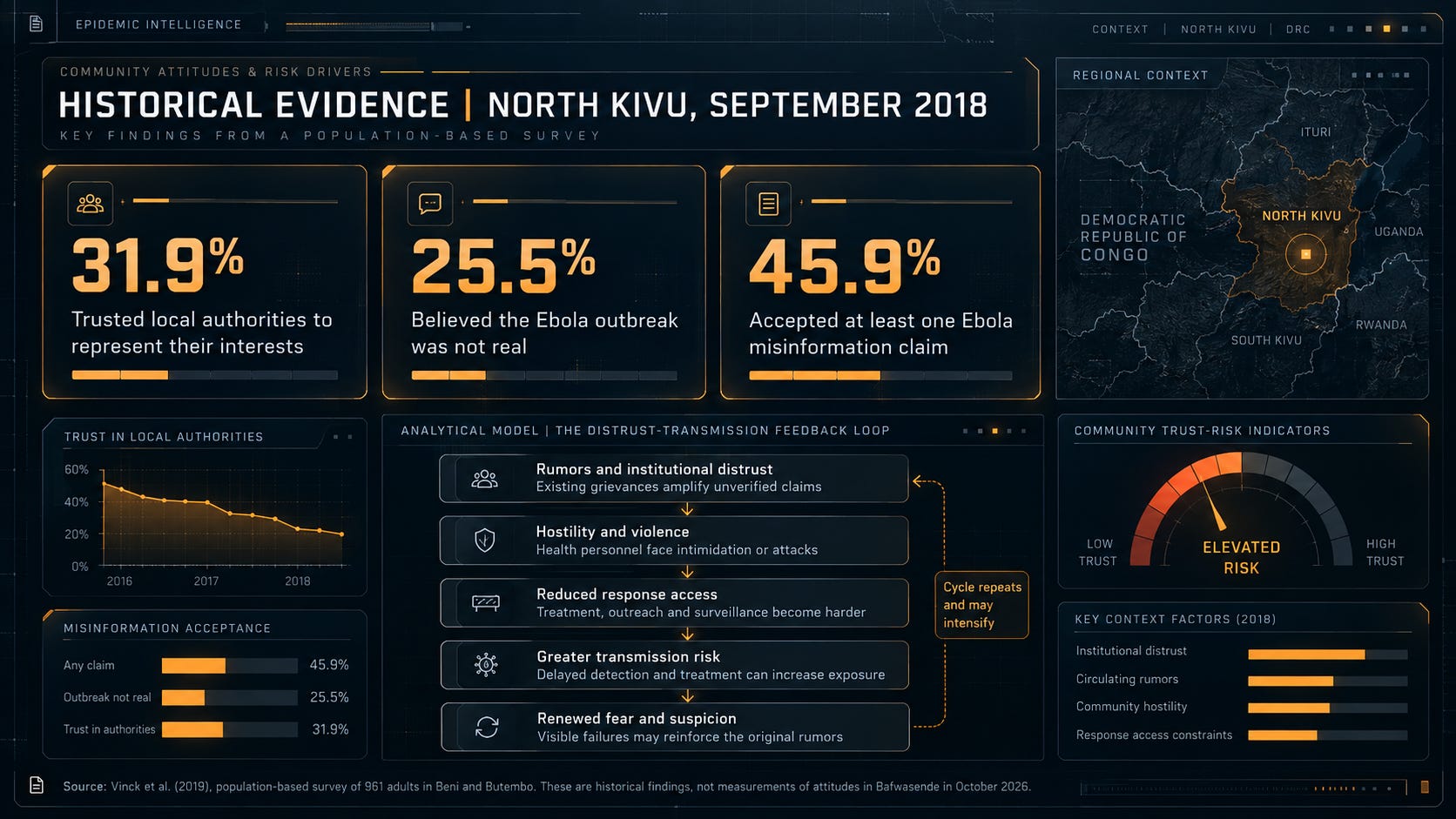
The distinction between actual corruption and perceived corruption is essential.
Actual corruption involves identifiable abuses of entrusted power for private gain. Perceived corruption concerns what citizens believe institutions and their representatives may be doing, whether those beliefs are supported by documented misconduct, personal experiences, political narratives, or misinformation.
Both can influence behavior, but through different mechanisms.
When citizens have repeatedly encountered allegations of diverted public funds, unequal access to services, patronage, or opaque decision-making, they may begin interpreting unfamiliar government initiatives through that existing framework of suspicion.
A sudden influx of emergency funding can consequently produce two competing interpretations.
To health authorities, it represents additional resources needed to contain a dangerous disease.
To some residents, it may raise an entirely different question: Why can the government mobilize substantial resources to confront Ebola when ordinary healthcare, public infrastructure, and community security have remained neglected?
That question is not inherently irrational.
Indeed, research examining the 2018–2020 outbreak documented widespread suspicions that Ebola response activities had become an opportunity for financial gain. The expression Ebola is a business emerged as a way of articulating frustration with the perceived financial and political interests surrounding the epidemic [8].
Such perceptions do not establish that an epidemic was fabricated or that medical personnel were deliberately spreading disease. They reveal how preexisting governance grievances can influence the interpretation of otherwise legitimate emergency interventions.
Transparency becomes critical at precisely this point.
When authorities do not clearly explain how emergency resources are allocated, why some communities receive assistance before others, how medical decisions are made, or how allegations of misconduct are investigated, they leave unanswered questions that misinformation can exploit.
And the resulting problem is not simply that people lack information.
It is that they lack confidence in the institutions providing it.
The Democratic Republic of Congo’s wider governance environment reinforces the importance of this distinction. Transparency International’s 2025 Corruption Perceptions Index assigned the country a score of 20 out of 100, reflecting substantial concerns about perceived public-sector corruption [9]. This national measure does not establish the prevalence of corruption within Ebola response operations, much less within the Bafwasende health zone. It does, however, provide important context for understanding the country’s broader institutional credibility challenges.
Where corruption perceptions enter the feedback loop
The relationship operates through several reinforcing mechanisms.
First, perceived corruption undermines institutional credibility. Official explanations may be received skeptically before their factual content has even been evaluated.
Second, limited transparency creates information gaps. When authorities fail to communicate clearly or explain controversial decisions, alternative narratives can appear more persuasive.
Third, perceived inequality and exclusion can deepen resentment. Communities may see highly resourced emergency operations alongside chronically underfunded local services, reinforcing suspicions about institutional priorities.
Finally, misinformation can transform these grievances into behavioral resistance. Residents may avoid treatment, conceal symptoms, refuse cooperation, or interpret healthcare personnel as representatives of institutions they distrust.
Research on Congo’s earlier Ebola response identified failures to meaningfully involve communities in decision-making, despite extensive efforts to collect community feedback. This distinction between listening to communities and allowing their concerns to influence operations is especially important [10].
There is, however, another side to this relationship worth examining.
Transparency can help interrupt the cycle.
Research on community feedback during the 2018–2020 outbreak documented how changes to response practices, including the introduction of transparent body bags during safe burials, helped address suspicions surrounding the handling of deceased patients [11].
This provides an instructive lesson: trust can sometimes be strengthened through observable procedural changes, not merely persuasive messages.
For Bafwasende, the analytical implications are substantial, but the extent of the current relationship remains unquantified. We do not yet have sufficient local evidence to determine whether perceived corruption was a primary driver of the October 2026 violence or one contributing factor among several.
What the historical evidence does establish is that corruption perceptions, institutional distrust, and limited transparency can interact in ways that weaken epidemic response capacity.
And that brings us to the larger governance question.
We often treat misinformation as a problem of what people believe. Yet perhaps we should devote equal attention to why they distrust the institutions asking them to believe something different.
Because when authorities have lost public credibility, facts alone may struggle to restore cooperation.
The strategic vulnerability is not simply that misinformation circulates. It is that perceived corruption and institutional opacity can create the conditions in which misinformation becomes believable, resistance becomes rationalized, and violence against essential service providers becomes possible.
If the response to Bafwasende addresses the rumors without addressing the underlying conditions of distrust, authorities may contain the immediate disturbance while leaving the feedback loop substantially intact.
And that is how a crisis of confidence can continue undermining public health long after the immediate security incident has ended.
References
1. Reuters. “Protesters Kill Longtime Nurse Treating Ebola Patients in Congo.” Reuters, 26 Oct. 2026. Read article.
2. Radio Okapi. “Un infirmier tué à Bafwasende sur fond de rumeurs liées à Ebola.” Radio Okapi, 25 Oct. 2026. Read article.
3. Actualité.cd. “Ebola dans la Tshopo : un infirmier pris pour cible et tué sur fond de rumeur à Bafwasende.” Actualité.cd, 25 Oct. 2026. Read article.
4. World Health Organization. Ebola Virus Disease, Democratic Republic of the Congo: External Situation Reports, 2018–2020. WHO Ebola outbreak resources.
5. Vinck, Patrick, et al. “Institutional Trust and Misinformation in the Response to the 2018–19 Ebola Outbreak in North Kivu, DR Congo: A Population-Based Survey.” The Lancet Infectious Diseases, vol. 19, no. 5, 2019, pp. 529–536. https://doi.org/10.1016/S1473-3099(19)30063-5.
6. Institute for Economics & Peace. Positive Peace Report 2024. IEP, 2024. Institute for Economics & Peace.
PART II
7. Vinck, P., Pham, P. N., Bindu, K. K., Bedford, J., & Nilles, E. J. (2019). Institutional trust and misinformation in the response to the 2018–19 Ebola outbreak in North Kivu, DR Congo: A population-based survey. The Lancet Infectious Diseases, 19(5), 529–536. https://doi.org/10.1016/S1473-3099(19)30063-5
8. Park, S.-J., et al. (2023). “Ebola is a business”: An analysis of the atmosphere of mistrust in the tenth Ebola epidemic in the Democratic Republic of the Congo. Critical Public Health, 33(3), 297–307. UK Foreign, Commonwealth & Development Office research record.
9. Transparency International. (2026). Corruption Perceptions Index 2025. https://www.transparency.org/en/cpi/2025
10. Mayhew, S. H., et al. (2021). Responding to the 2018–2020 Ebola virus outbreak in the Democratic Republic of the Congo: Rethinking humanitarian approaches. Risk Management and Healthcare Policy. Full text.
11. New mixed methods approach for monitoring community perceptions of Ebola and response efforts in the Democratic Republic of the Congo. (2021). Global Health: Science and Practice, 9(2), 332–343. https://doi.org/10.9745/GHSP-D-21-00144
Editorial verification note: The nurse’s death and resulting insecurity are corroborated by multiple sources. Reporting differs on whether the fatal attack occurred October 23 or October 24, and on the injured person’s professional role. Our editorial therefore refers to the weekend of October 24 without resolving those differences. Causal interpretations beyond the documented incident is our analysis rather than established investigative findings.
ARAC International Inc. | Global Security Analysis & Independent Research
Quanta Analytica™ - MNS Consulting | An LBS, LLC partner | Quanta AI | QAP™
Nuri Shakoor, SRMP-R, SRMP-C