


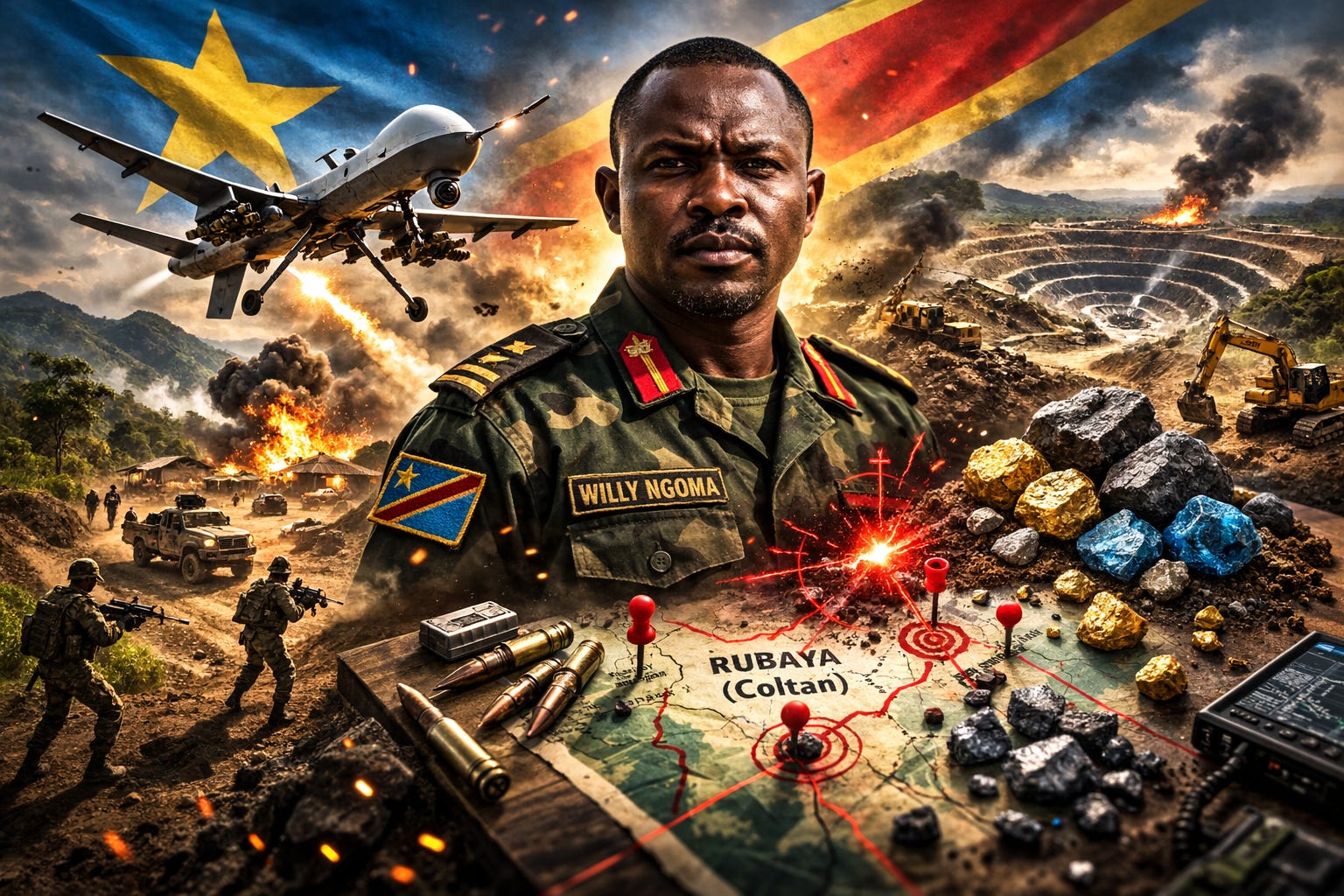
SitRep Eastern DR Congo: Drone Strike Kills M23 Rebel Group Commander Willy Ngoma
BLUF: Eastern DR Congo remains highly volatile, with M23 retaining significant territorial control in North Kivu, severe humanitarian deterioration, and multi‑actor violence; the FARDC drone strike killing M23 commander and spokesman Willy Ngoma near Rubaya is tactically significant and escalatory but has not yet produced major strategic or territorial shifts.[1][2][3][4][5][6][7]
1. Situation (as of 25 February 2026)
The security environment in eastern DRC, particularly North and South Kivu, is characterized by active front lines, fragmented armed actors, and large‑scale displacement. M23 continues to hold important areas in Rutshuru and Masisi territories, with fighting concentrated along key road axes and around Virunga National Park. The Rubaya coltan‑mining area in Masisi has become a focus of FARDC drone and artillery activity, culminating in the recent strike on Ngoma.[2][3][4][5][6][7][1]
Humanitarian conditions are acute, with recurrent attacks by armed groups displacing civilians and constraining humanitarian access. In South Kivu, new displacement has followed movements of AFC/M23‑linked elements and other armed groups, including around Uvira and Kamanyola. Disease outbreaks, including cholera and mpox, are reported in several affected zones, amplifying risks for IDPs and host communities.[5][2]
Politically, Kinshasa continues to accuse Rwanda of backing M23 and occupying portions of Congolese territory, while diplomatic tracks under the EAC, Luanda, and Nairobi processes struggle to produce durable ceasefires on the ground. Tshisekedi’s government frames operations against M23 as a national defense imperative, reinforcing a hard‑line posture and reducing near‑term appetite for compromise.[1]
2. Actor mapping and analysis
2.1 FARDC and allied militias
FARDC seeks to reassert state control over North Kivu, degrade M23, and demonstrate increased capabilities, including the operational use of drones. The drone strike that killed Ngoma shows improved targeting of high‑value M23 leadership, but FARDC remains constrained by logistics, discipline, and dependence on local militias (Wazalendo) for manpower and local intelligence. The integration of community‑based militias into operations creates short‑term gains while deepening long‑term governance and accountability risks.[3][4][7][5]
2.2 M23
M23 aims to consolidate control over strategic North Kivu zones, maintain resource access, and extract political concessions from Kinshasa. It retains relatively strong organization and armament compared with most local groups and continues to administer parallel governance structures, including taxation and local “governors.” Reports indicate efforts by its political wing to develop independent communications infrastructure (e.g., mobile networks) to circumvent Kinshasa’s authority in certain areas.[7][5]
The loss of Lt. Col. Willy Ngoma, a senior commander and military spokesman, is a notable blow to M23’s propaganda and command profile but does not by itself remove its core military capabilities. M23 leaders have accused FARDC of “total war” and indiscriminate bombing around Rubaya, suggesting a hardening stance and potential for retaliatory actions.[4][6][3]
2.3 Rwanda and anti‑Rwandan armed groups
Rwanda is widely reported by regional and international observers to support M23 materially, despite official denials, with objectives that include containing FDLR threats and securing influence over resource‑rich areas. Kigali’s posture and accusations of FDLR activity from eastern Congo feed into a regionalized narrative that constrains diplomatic solutions.[5][7][1]
FDLR and other anti‑Rwandan groups remain degraded but still active in parts of eastern DRC, sometimes tactically aligned with FARDC‑friendly actors, and serve as a central security concern cited by Rwanda. Their presence sustains mutual threat perceptions between Kigali and Kinshasa and provides justification for continued militarization.[7][1][5]
2.4 Civilians, civil society, and humanitarian actors
Civilians face widespread threats including forced displacement, arbitrary detention, looting, and sexual violence from multiple parties. Humanitarian actors operate in a constrained environment, with documented ambushes, looting, and road insecurity, such as attacks on medical and relief convoys in North Kivu. Local civil society organizations play critical roles in documentation and service provision but face intimidation and resource scarcity.[2][5]
To access the full assessment, priority indicators, and sources, consider a paid subscription to support independent research and analysis. Also, there is a companion report for founding members and consultants who need foresight and trajectory analysis grounded in analytic tradecraft.